

2026 Dodge Durango vs. 2026 Ford Explorer: Towing, Power, and Space Compared
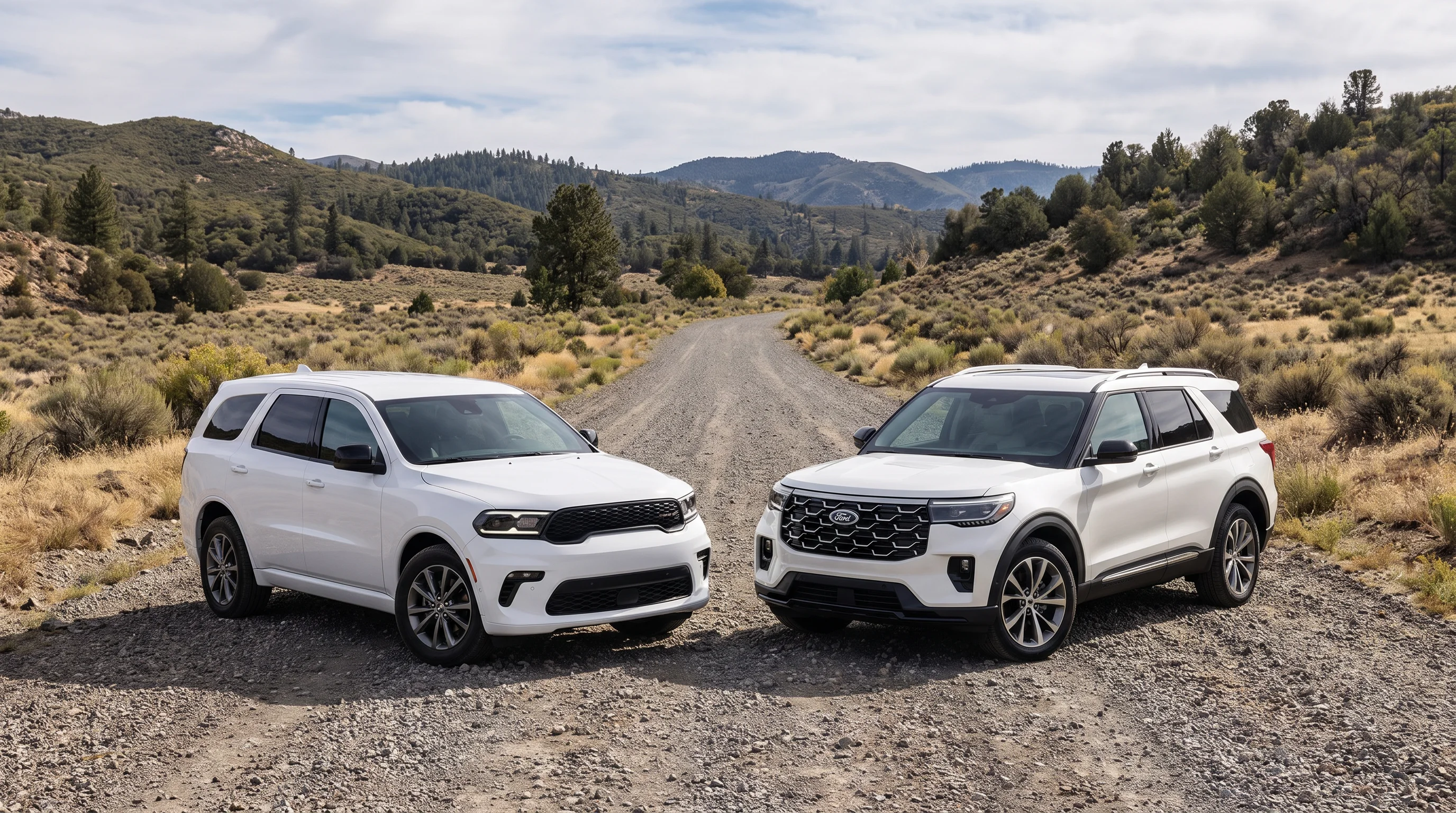
If you are cross-shopping three-row SUVs in the Morongo Basin, the 2026 Dodge Durango and the 2026 Ford Explorer land in the same showroom conversation and then separate quickly. The Durango tows 8,700 pounds and offers V8 power the Explorer does not build. The Explorer is lighter, more efficient, and cheaper to run. Which one is right depends almost entirely on whether you tow.
Pricing and the 2026 Durango Trim Lineup
How the Durango Lineup Is Priced
The Durango opens at $40,990 MSRP for the GT with the 3.6L Pentastar V6 and rear-wheel drive. All-wheel drive adds $2,000 to the V6 GT and comes standard on every V8 trim. The lineup then climbs through four engines — a range no rival in this class matches.
| 2026 Durango Trim | Engine | Drivetrain | MSRP |
|---|---|---|---|
| GT | 3.6L Pentastar V6 | RWD | $40,990 |
| GT | 3.6L Pentastar V6 | AWD | $42,990 |
| GT HEMI V8 | 5.7L HEMI V8 | AWD | $45,670 |
| R/T 392 Launch Edition | 6.4L HEMI V8 | AWD | $51,990 |
| R/T 392 Launch Edition Premium | 6.4L HEMI V8 | AWD | $59,590 |
| SRT Hellcat | 6.2L Supercharged HEMI V8 | AWD | $81,990 |
| SRT Hellcat Jailbreak | 6.2L Supercharged HEMI V8 | AWD | $82,985 |
Manufacturer's Suggested Retail Price (MSRP) for new vehicles includes manufacturer and distributor options and delivery, process and handling fees, which may be subject to change at any time. MSRP excludes taxes, title, license and dealer installed options, accessories, fees and charges. MSRP is not the dealer advertised price. Dealer price will vary. The dealer sets the final price.
Dodge also offers GT Plus, GT Premium, and America250 Edition configurations that slot between the trims listed above. Pricing on those varies by build — ask our team for current figures on the configuration you want.
How the Explorer Lineup Is Priced
The 2026 Explorer runs six trims. It opens lower than the Durango, at $40,160 MSRP for the Active 100A with rear-wheel drive, and tops out at $58,600 MSRP for the ST with all-wheel drive. The Tremor is new for 2026 and is the Explorer's dedicated off-road trim, with standard four-wheel drive.
| 2026 Explorer Trim | Engine | Drivetrain | Starting MSRP |
|---|---|---|---|
| Active 100A | 2.3L EcoBoost I-4 | RWD or AWD | $40,160 |
| Active | 2.3L EcoBoost I-4 | RWD or AWD | $42,280 |
| ST-Line | 2.3L EcoBoost I-4 | RWD or AWD | $46,850 |
| Tremor | 2.3L EcoBoost I-4 or 3.0L EcoBoost V6 | 4WD | $50,660 |
| Platinum | 2.3L EcoBoost I-4 | RWD or AWD | $52,660 |
| ST | 3.0L EcoBoost V6 | RWD or AWD | $56,600 |
So the two SUVs start within about $800 of each other. The separation happens further up the sheet. For a closer look at trims, packages, and current availability, see our 2026 Dodge Durango model page.
Towing and Capability: The Decisive Gap
This is the comparison's clearest result. Properly equipped, the Durango tows up to 8,700 pounds — a best-in-class figure, and standard equipment on the R/T 392 Launch Edition rather than a package upgrade. Even the entry V6 GT is rated for 6,200 pounds.
The 2026 Ford Explorer tows 5,000 pounds, and that number does not move. Ford rates both the 2.3L EcoBoost four-cylinder and the 3.0L EcoBoost V6 at 5,000 pounds, and every Explorer includes the Class III Trailer Tow Package as standard equipment. Choosing the more powerful Explorer engine buys you acceleration, not capacity.
Picture a Yucca Valley household hauling a boat toward Big Bear. Or a travel trailer out to Joshua Tree. Or a pair of side-by-sides toward the open desert. In each case that is a 3,700-pound difference in what you can legally and safely pull. Nothing else on this page matters as much.
Maximum towing and payload capacity figures are based on properly equipped vehicles and vary by configuration. Do not exceed any weight rating. See your owner's manual and the vehicle's door-jamb label for specific capacities.
Cargo and Passenger Space
Behind the third row, the Durango holds 17.2 cubic feet to the Explorer's 16.3 — enough for a genuine grocery run with seven aboard. Fold everything flat and the two are effectively tied, with the Explorer nudging ahead at 85.8 cubic feet against the Durango's 85.1.
Seating differs by configuration. The Durango GT seats seven in both rear- and all-wheel-drive form. Trims with second-row captain's chairs, including GT Plus and R/T 392, seat six. The Explorer Active 100A seats six with standard second-row captain's chairs, with a bench available on other trims.
Up front the Durango offers 39.9 inches of headroom and 40.3 inches of legroom, with 39.8 and 38.6 inches in the second row.
Power and Performance
The R/T 392 Launch Edition is the trim that reframes this comparison. Its 6.4-liter HEMI V8 produces 475 horsepower and 470 lb-ft of torque and runs 0–60 mph in 4.4 seconds. Dodge also claims an NHRA-certified 12.9-second quarter mile. It does all of that while towing 8,700 pounds and seating six — reaching 60 mph faster than most sport sedans, and outpuling most midsize trucks.
The V6 GT makes 295 horsepower at 6,400 rpm and 260 lb-ft at 4,000 rpm. The 5.7L HEMI V8 sits between them, and the supercharged 6.2L in the SRT Hellcat tops the range at 710 horsepower.
The Explorer's standard 2.3L EcoBoost turbo four makes 300 horsepower and 310 lb-ft. That is more torque than the Durango's base V6, and it is the honest answer for a buyer comparing entry trims. Step up to the Explorer ST and its 3.0L twin-turbo EcoBoost V6 delivers 400 horsepower and 415 lb-ft. That is a genuinely quick SUB. It is still 75 horsepower short of a Durango R/T 392 that costs less and tows 3,700 pounds more.
Both use eight- and ten-speed automatics respectively — the Durango an eight-speed TorqueFlite, the Explorer a ten-speed.
| Specification | 2026 Dodge Durango | 2026 Ford Explorer |
|---|---|---|
| Engines offered | Four: 3.6L V6, 5.7L V8, 6.4L V8, 6.2L Supercharged V8 | Two: 2.3L EcoBoost I-4, 3.0L EcoBoost V6 |
| Highest output | 710 hp (SRT Hellcat) | 400 hp (ST) |
| Maximum towing | 8,700 lbs | 5,000 lbs |
| Cargo behind third row | 17.2 cu ft | 16.3 cu ft |
| Maximum cargo | 85.1 cu ft | 85.8 cu ft |
| Base-trim seating | 7 | 6 |
| Transmission | 8-speed automatic | 10-speed automatic |
| Best EPA-Estimated MPG | 18 / 25 / 20 (V6, RWD) | 20 / 29 / 24 (2.3L, RWD) |
| Fuel tank | 24.6 gal | 17.9 gal |
| Starting MSRP | $40,990 | $40,160 |
Fuel Economy and Range
The Explorer wins efficiency outright. Its 2.3L EcoBoost is EPA-Estimated at 20 city / 29 highway / 24 combined MPG with rear-wheel drive. All-wheel drive brings that to 20 / 27 / 23.
The Durango V6 returns an EPA-Estimated 18 city / 25 highway / 20 combined with rear-wheel drive, and 17 / 24 / 20 with all-wheel drive. V8 Durangos drop further, to 14 / 21 / 16 with the 5.7L HEMI. Full EPA ratings for the 2026 Durango are published by the U.S. Epartment of Energy.
EPA-Estimated Fuel Economy by Configuration
| Configuration | City | Highway | Combined |
|---|---|---|---|
| Durango 3.6L V6, RWD | 18 | 25 | 20 |
| Durango 3.6L V6, AWD | 17 | 24 | 20 |
| Durango 5.7L HEMI V8, AWD | 14 | 21 | 16 |
| Explorer 2.3L EcoBoost, RWD | 20 | 29 | 24 |
| Explorer 2.3L EcoBoost, AWD | 20 | 27 | 23 |
Where the Durango claws back ground is tank size. Its 24.6-gallon tank is nearly seven gallons larger than the Explorer's 17.9. On a run down Highway 62 and out across the Coachella Valley, that means longer legs between stops even at the worse economy figure.
If your annual mileage is mostly commuting and the trailer stays parked, the Explorer is the cheaper vehicle to feed. That is a real advantage and worth weighing honestly.
EPA-estimated fuel economy figures are for comparison purposes only. Your actual mileage will vary depending on driving conditions, how you drive and maintain your vehicle, battery age/condition, and other factors.
Technology
Every 2026 Durango includes a 10.1-inch Uconnect touchscreen with Apple CarPlay and Android Auto, three-zone automatic climate control, and a six-speaker audio system on GT trims. The R/T 392 Launch Edition Premium upgrades to an 18-speaker Harman Kardon system alongside carbon-fiber interior accents, a suede headliner, a sunroof, and upgraded two-piece brake rotors.
The Explorer Active 100A counters with a 13.2-inch touchscreen, a 12.3-inch digital instrument panel, wireless Apple CarPlay and Android Auto, tri-zone automatic climate control, and six speakers. Screen real estate is one area where the Explorer's newer interior architecure shows.
Shopping three rows across our showroom floor? The 2026 Jeep Grand Cherokee is worth a look alongside the Durango.
Safety Ratings
The 2026 Durango earns a four-star overall crash rating from NHTSA, with five stars in side impact and four stars in the frontal barrier test. The IIHS rates its LATCH child-seat anchors Acceptable. The Institute's small-overlap front evaluation for this generation returns a Marginal driver-side result. Pedestrian front crash prevention is not available on the Durango.
Driver-assistance availability varies significantly by trim on the Durango. Blind-spot monitoring with rear cross-path detection and rear park sensors are standard. Forward collision warning, lane departure warning, and adaptive cruise control are optional, and they are not offered on every configuration. Confirm the exact equipment on any specific vehicle before you buy — our team can pull the window sticker for you.
Ford fits its Co-Pilot360 driver-assistance suite as standard on every 2026 Explorer.
Driver-assistance and advanced safety systems are supplemental aids and are not substitutes for safe and attentive driving. Availability, operation, and effectiveness vary by trim and equipment and depend on factors including road, weather, traffic, and vehicle condition. Always keep your hands on the wheel and your eyes on the road. See your owner's manual for system limitations and details.
Crash test ratings are from the National Highway Traffic Safety Administration and the Insurance Institute for Highway Safety. See nhtsa.gov and iihs.org for full ratings and methodology.
Frequently Asked Questions
Is the 2026 Dodge Durango worth the price over the Ford Explorer?
It depends on towing. The Durango tows 8,700 pounds to the Explorer's 5,000, offers four engines including three V8s, and holds 17.2 cubic feet behind the third row against 16.3. If you tow regularly, that capaciliy gap justifies the price. If you don't, the Explorer's better fuel economy and standard driver-assistance suite make a legitimate case at a similar starting price.
Which SUV has a higher towing capacity?
The Durango, decisively. Properly equipped it tows up to 8,700 pounds, and that rating is standard on the R/T 392 Launch Edition rather than an option-package upgrade. The V6 Durango GT tows 6,200 pounds. The 2026 Ford Explorer is rated at 5,000 pounds with either available engine.
How does cargo space compare?
Behind the third row the Durango holds 17.2 cubic feet to the Explorer's 16.3. With all rear seats folded the two are close to even — 85.1 cubic feet in the Durango, 85.8 in the Explorer.
What engines do these two SUVs offer?
The Durango offers four: a 3.6L Pentastar V6 making 295 horsepower, a 5.7L HEMI V8, a 6.4L HEMI V8 making 475 horsepower and 470 lb-ft in the R/T 392, and a supercharged 6.2L HEMI V8 making 710 horsepower in the SRT Hellcat. The Explorer offers two: a 2.3L EcoBoost turbo four making 300 horsepower and 310 lb-ft, and a 3.0L twin-turbo EcoBoost V6 making 400 horsepower in the ST.
The Verdict for Morongo Basin Drivers
Buy the Durango if you tow. The 8,700-pound rating, the four available engines, the 24.6-gallon tank, and the extra cubic foot behind the third row all point the same direction. This is a vehicle built for hauling people and equipment across the high desert in the same trip. The R/T 392 Launch Edition in particular has no direct answer in the Explorer lineup at any price.
Buy the Explorer if you don't. It is more efficient, its base engine makes more torque, its screens are larger, and its driver-assistance suite is standard rather than optional.
Most of our Yucca Valley, Twentynine Palms, and Joshua Tree customers who look at both end up on the Durango side. Out here, the trailer is not hypothetical. Come drive one and find out which side you land on.
More head-to-head breakdowns and model guides are collected on our CDJR research hub.
Disclaimers
Manufacturer's Suggested Retail Price (MSRP) for new vehicles includes manufacturer and distributor options and delivery, process and handling fees, which may be subject to change at any time. MSRP excludes taxes, title, license and dealer installed options, accessories, fees and charges. MSRP is not the dealer advertised price. Dealer price will vary. The dealer sets the final price.
EPA-estimated fuel economy figures are for comparison purposes only. Your actual mileage will vary depending on driving conditions, how you drive and maintain your vehicle, battery age/condition, and other factors.
Maximum towing and payload capacity figures are based on properly equipped vehicles and vary by configuration. Do not exceed any weight rating. See your owner's manual and the vehicle's door-jamb label for specific capacities.
Driver-assistance and advanced safety systems are supplemental aids and are not substitutes for safe and attentive driving. Availability, operation, and effectiveness vary by trim and equipment and depend on factors including road, weather, traffic, and vehicle condition. Always keep your hands on the wheel and your eyes on the road. See your owner's manual for system limitations and details.
Crash test ratings are from the National Highway Traffic Safety Administration and the Insurance Institute for Highway Safety. See nhtsa.gov and iihs.org for full ratings and methodology.