

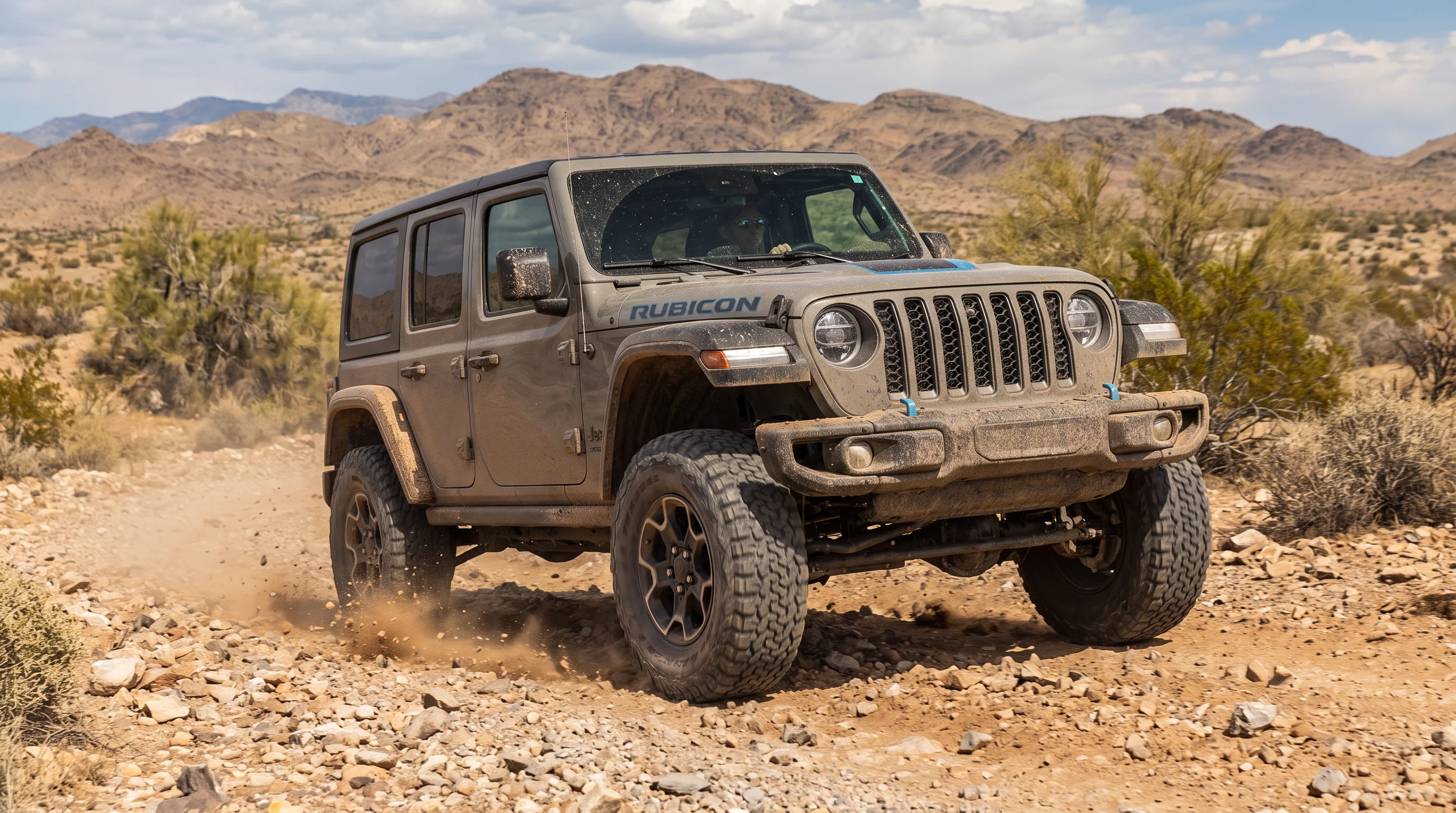
Are There Real 4x4 Trails in Joshua Tree National Park?
Joshua Tree National Park contains multiple designated backcountry dirt roads open to four-wheel-drive and high-clearance vehicles, including Old Dale Road, Berdoo Canyon Road, and Geology Tour Road. Driving off those designated roads is illegal inside park boundaries — the National Park Service cites damage to vegetation, fragile soil crusts, and animal burrows, including those of the federally threatened desert tortoise. Every vehicle traveling these routes must be registered and street-legal according to California state law.
Drivers visiting our showroom often ask whether a standard crossover can handle Geology Tour Road. The National Park Service designates that road High Clearance and 4-Wheel-Drive Required. Most passenger vehicles can reach the first few miles in good weather, but a sign marks the point beyond which four-wheel drive is recommended and high clearance becomes necessary — past it, the route runs into deep ruts and soft sand. The Park Service also prohibits ATVs, UTVs, OHVs, and dirt or motocross bikes anywhere in the park. Every vehicle operating inside park boundaries needs valid registration and license plates.
Because cell phone reception is very limited throughout the park — the Park Service recommends carrying a satellite communication device — mechanical reliability becomes a top safety priority. Running these designated roads means carrying a fully inflated spare tire, adequate underbody clearance, and recovery gear. If you want to look at a trail-ready vehicle before heading into the desert, stop by our Yucca Valley showroom or contact our sales team.
What Are the Main 4x4 and High-Clearance Roads in Joshua Tree?
The National Park Service lists seven backcountry road areas in Joshua Tree National Park. Six of them are designated High Clearance and 4-Wheel-Drive Required. The seventh, Queen Valley Roads, is a 13.4-mile network suitable for most two-wheel-drive vehicles.
| Road | Length | NPS Requirement | Where It Starts | What to Expect |
|---|---|---|---|---|
| Geology Tour Road | 18 miles round trip | High clearance and 4WD required | Turns south off the paved road two miles west of Jumbo Rocks Campground | 5.4 miles to Paac Küvühü’k, mostly downhill but bumpy and sandy, then a six-mile loop through Pleasant Valley. The Park Service puts the full round trip at approximately two hours. The most accessible entry point in the park. |
| Berdoo Canyon Road | 11.5 miles | High clearance and 4WD required | South end of Geology Tour Road, running to Dillon Road | Deep sand, sharp bedrock, and rough boulders. A bedrock pinch in the northern canyon and a boulder pinch mid-canyon may deny passage to full-size trucks. |
| Old Dale Road | 23 miles | High clearance and 4WD required | 6.5 miles north of the Cottonwood Visitor Center, at the park’s south end | The first 11 miles cross Pinto Basin, a flat sandy dry lakebed with sections of deep sand. The road then climbs a steep hill and exits the park. The Park Service calls that hill and the miles beyond it some of the most technical and rough 4x4 segments in the greater area, and notes a washout on the final climb that may be impassable to vehicles without a short wheelbase. |
| Black Eagle Mine Road | Dead-end route | High clearance and 4WD required | Same starting point as Old Dale Road | Runs along the edge of Pinto Basin, crosses several dry washes, and winds through canyons in the Eagle Mountains past historic mining sites. The first nine miles are inside the park; the middle segment holds some of the deepest sand in the park. |
| Pinkham Canyon and Thermal Canyon Roads | About 20 miles of route options | High clearance and 4WD required | West and south from the Cottonwood Visitor Center | Starts well-compacted and brushy, then transitions to stone cobble and sandy wash with rough boulders. A boulder pinch point in the upper canyon may be impassable to larger vehicles. |
| Covington Flat Roads | 3.8 miles one way | High clearance and 4WD required | Lower Covington Flat picnic area | Climbs to Eureka Peak, steep near the end, with views of Palm Springs, the surrounding mountains, and the Morongo Basin. |
Backcountry roads close temporarily after significant rain events, and closures are posted on the park’s alerts and conditions page. Moving into a fully capable trail vehicle lets you explore these routes with confidence — you can start with our new Jeep inventory in Yucca Valley.
What Kind of Vehicle Do You Need for Joshua Tree 4x4 Roads?
Traveling the designated unpaved roads in Joshua Tree National Park requires a street-legal vehicle with genuine four-wheel drive, a low-range transfer case, and high ground clearance. Standard all-wheel-drive crossovers built for rain and pavement lack the low-speed crawl power and underbody protection needed for deep sand washes and rocky canyon drop-offs.
A purpose-built off-road vehicle like a Jeep Wrangler provides the traction, articulation, and wheel travel these routes demand.
2026 Jeep Wrangler Four-Wheel-Drive Systems
| System | Type | Availability |
|---|---|---|
| Command-Trac | Part-time 4x4 | Available on Wrangler |
| Selec-Trac | Full-time 4x4 | Available on Wrangler |
| Rock-Trac | Part-time 4x4 with a 4:1 low gear ratio for technical low-speed work | Exclusive to Rubicon models |
Source: 2026 Jeep Wrangler capability.
What Your Vehicle Needs on These Roads
| Requirement | Why It Matters Out Here |
|---|---|
| True 4WD with low range | Engaging 4WD Low multiplies engine torque at slow speeds, preventing tire spin in deep, soft sand and allowing controlled descents down rocky grades. |
| Underbody protection | Factory or aftermarket skid plates protect the oil pan, transfer case, and fuel tank from stray rocks and high-centered obstacles. |
| High ground clearance | The Park Service designates six of its backcountry roads High Clearance and 4-Wheel-Drive Required, specifically to clear embedded rock and deep wash ruts. |
| All-terrain tires | Reinforced sidewalls reduce the risk of punctures on sharp rock. Tire type is a recommendation rather than a park requirement — what the Park Service does require you carry is a fully inflated spare. |
Exploring rough backcountry routes like Old Dale Road calls for genuine trail-rated hardware, not highway-comfort tuning.
Where Do Drivers Start for Joshua Tree Trail Access Near Yucca Valley?
Drivers accessing Joshua Tree’s backcountry roads from Yucca Valley usually enter at the West Entrance Station near the town of Joshua Tree, or travel east along Highway 62 toward Twentynine Palms. Starting from Yucca Valley puts you minutes from the main park gates and staging areas where you can check trail supplies.
Drivers coming up from Palm Springs and the Coachella Valley reach Yucca Valley by taking Highway 62 north from Interstate 10. The West Entrance opens onto Park Boulevard, which carries you to the Geology Tour Road junction two miles west of Jumbo Rocks Campground. Old Dale Road and Black Eagle Mine Road are a different proposition: both begin 6.5 miles north of the Cottonwood Visitor Center at the park’s south end. Old Dale Road’s northern end does meet Highway 62 about fifteen miles east of Twentynine Palms, but the Park Service describes that stretch as among the most technical and rough 4x4 segments in the area — it functions as an exit, not a recommended way in.
Where to Buy a Park Pass in Yucca Valley
Every visitor needs an entrance pass, and three of the Park Service’s in-person sales locations are right here in Yucca Valley: the California Welcome Center at 56711 Twentynine Palms Highway, the JTNPA West Park Store at 55922 Twentynine Palms Highway, and Black Rock Nature Center at 9800 Black Rock Canyon Road. All three accept cash or card.
Buying locally before you head for the gates means you are not relying on connectivity at an entrance station.
Before You Leave Pavement
Make sure your fuel tank is full. There are no gas stations inside park boundaries, and vehicles burn fuel faster in challenging off-road conditions. Airing down all-terrain tires slightly at the trailhead improves traction over soft sand, but bring a portable compressor to reinflate before returning to high-speed asphalt.
Frequently Asked Questions About Off-Roading in Joshua Tree
Can I drive non-street-legal UTVs or dirt bikes in Joshua Tree National Park?
No. ATVs, UTVs, OHVs, and dirt or motocross bikes are prohibited inside Joshua Tree National Park. All vehicles and dual-sport motorbikes must be registered and street-legal according to California state law, with valid license plates. Drivers looking for open off-highway vehicle riding areas need to use Bureau of Land Management lands outside the park boundaries.
How long does it take to drive the full Geology Tour Road loop?
The Park Service puts the 18-mile Geology Tour Road round trip at approximately two hours. Most passenger vehicles can reach the first few miles in good weather, but a sign marks the point beyond which four-wheel drive is recommended and high clearance becomes necessary — past that point the route runs into deep ruts and soft sand, and the posted speed limit is 25 mph.
Is vehicle camping or dispersed camping allowed along backcountry roads in Joshua Tree?
No. Car camping and dispersed camping are prohibited on backcountry roads inside Joshua Tree National Park, along with fires, vegetation collection, drone use, and shooting. Camping inside the park must take place in designated campgrounds, or in the backcountry by permit only. Drivers seeking free dispersed camping use Bureau of Land Management land outside the park, where a 14-day stay limit applies.
What seasonal weather hazards should drivers prepare for on desert 4x4 roads?
Summer daytime highs in the park are typically near or above 100 degrees, and the Park Service advises carrying extra ice and water in case air conditioning becomes inoperable. Heavy desert rain damages low-lying canyon roads, and it is common for backcountry roads to close temporarily after significant rain events. Check forecasts and the park’s road advisories, and never attempt to cross a flooded segment.
Do I need a permit to drive on 4x4 dirt roads in Joshua Tree?
No special off-road driving permit exists for Joshua Tree National Park. Beyond a standard park entrance pass, no additional permit is required to travel the designated backcountry roads. Vehicles must remain street-legal and stay on marked, open roads at all times.
Preparing Your Jeep or Ram 4x4 for Desert Roads
Preparing a four-wheel-drive vehicle for Joshua Tree’s backcountry roads means inspecting underbody components, checking fluid levels, verifying tire pressures, and packing supplies. Desert driving puts elevated stress on cooling systems, transfer cases, and tires, and a breakdown out here happens well beyond cell service.
Carry a fully inflated spare tire, a jack, recovery straps, and extra drinking water for every passenger. The Park Service notes that a backcountry rescue can take many hours or, in some cases, days.
Ready to look at something built for this terrain? Browse our new Jeep inventory in Yucca Valley at 57909 29 Palms Highway.