
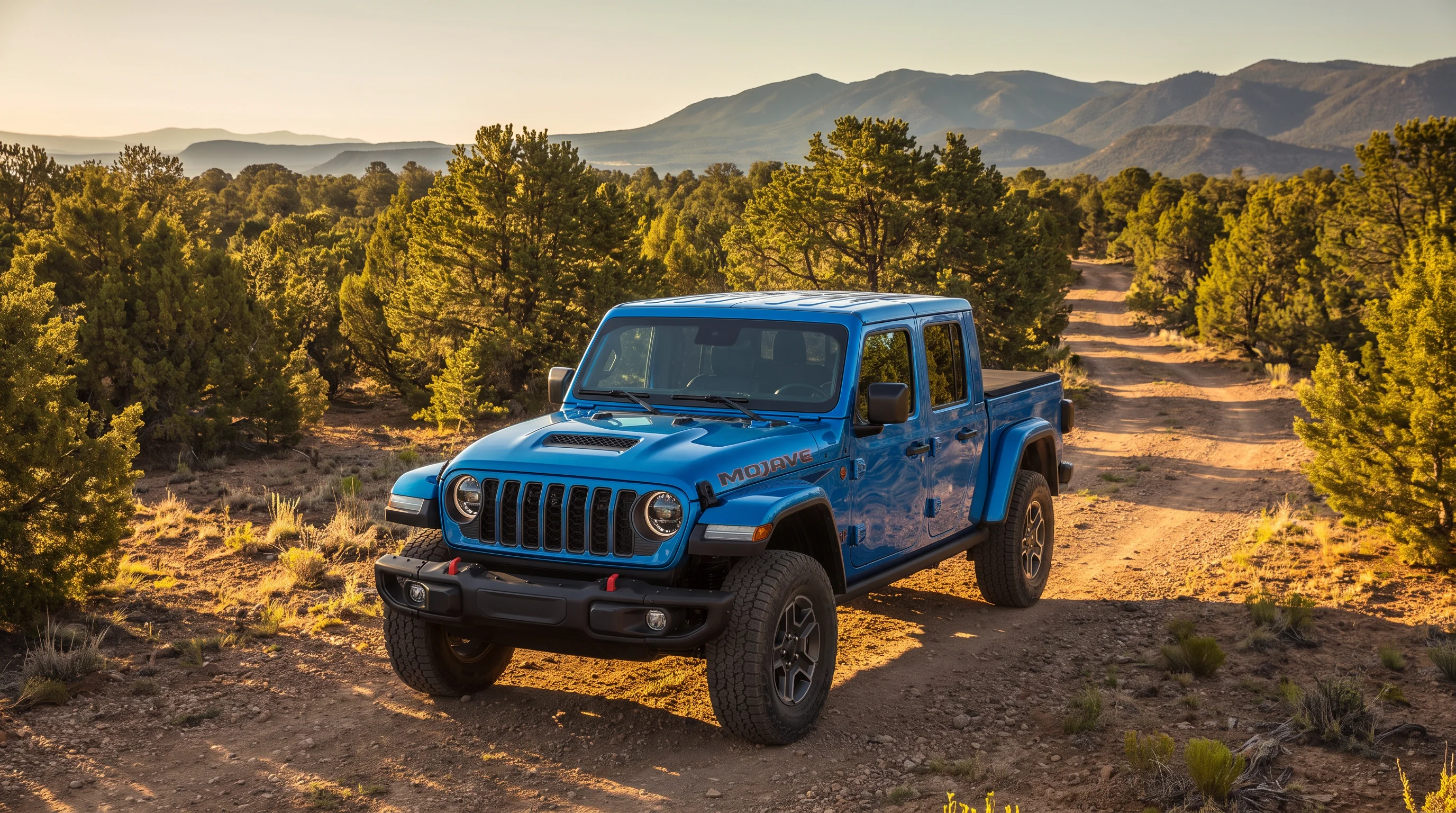
Jeep Gladiator Routine Maintenance Schedule (2020–2027)
The routine maintenance schedule for a Jeep Gladiator is built around one recurring visit — an engine oil and filter change, a tire rotation and a brake inspection at every oil change interval, never exceeding 10,000 miles, 12 months or 350 hours of engine run time, whichever comes first. Larger milestone services stack on top of that at 30,000, 60,000, 90,000 and 100,000 miles.
Maintaining a midsize pickup built on heavy-duty 4WD hardware takes a structured schedule rather than a guess at the odometer. Here is how the milestones break down under normal driving conditions.
The 30/60/90K Milestone Ladder
| Service Milestone | What Is Performed |
|---|---|
| Every oil change service — set by the oil change indicator; never exceed 10,000 miles, 12 months, or 350 engine hours | Replace engine oil and filter. Rotate all four tires, or five if you run a matched full-size spare. Inspect brake pads, rotors, hoses and the parking brake. Lubricate front suspension chassis components, inspect battery terminals and cables, and top off underhood fluids. |
| 12,000 miles, and every 12,000 after | Replace the cabin air filter. |
| 30,000 miles | Everything above, plus replace the engine air filter and inspect front and rear axle fluid, transfer case fluid, exhaust heat shields, and suspension and steering linkages. |
| 60,000 miles | Everything above, plus replace transfer case fluid and front and rear differential fluid on the severe schedule, which covers off-road use, towing and heavy dust. Check brake linings, parking brake adjustment and CV joints. |
| 90,000 miles | The recurring oil, rotation and brake items, plus the third engine air filter replacement and the 30,000-mile driveline inspections. No separate major service falls at this mark. |
| 100,000 miles | Everything above, plus replace spark plugs and inspect the PCV valve and accessory drive belt. |
| 150,000 miles | Replace driveline fluids on the normal-duty schedule. Engine coolant gets its first replacement at 10 years or 150,000 miles, then every 5 years or 100,000 miles after that. |
Normal Duty vs. Severe Duty
Which column your Gladiator falls into changes several intervals outright, and in the high desert most trucks sit on the right-hand side more often than their owners expect.
| Service item | Normal duty | Severe duty |
|---|---|---|
| What counts as this | Mostly highway miles, light loads, mild conditions | Off-road use, towing, rock crawling, heavy dust, sustained extreme heat |
| Engine oil and filter | Up to 10,000 miles or 12 months, as the indicator calls it | Indicator commonly calls for service by 3,500 to 5,000 miles |
| Engine air filter | Replace at 30,000 miles | Inspect at every oil change and replace as needed |
| Transfer case fluid | Replace on the 150,000-mile driveline schedule | Replace at 60,000 miles |
| Front and rear differential fluid | Replace on the 150,000-mile driveline schedule | Replace at 60,000 miles, and inspect immediately after any water crossing |
Two details matter more here than they would in a milder climate. Dusty driving conditions across the Morongo Basin high desert call for inspecting the engine air filter at every oil change rather than waiting for the 30,000-mile interval. The 350-hour engine run-time limit sits alongside mileage and time as a third ceiling; Jeep notes it is generally only a concern for fleet-use vehicles, but it is worth knowing it exists if your truck piles up idle hours.▲
▲ The information in this article is general guidance and does not constitute a specific diagnostic or repair recommendation for any individual vehicle. Repair and maintenance decisions should be made in consultation with a certified technician based on the specific condition of your vehicle.
For local support, bring your Gladiator to our Yucca Valley service center or call our service advisors at (760) 369-8997 to confirm which milestones apply to your VIN.
Cited Source: Jeep Owner’s Portal — official Jeep owner’s manual and scheduled maintenance information by model year
How Often Should You Change the Oil in a Jeep Gladiator?
Engine oil in the Jeep Gladiator should be changed when the oil change indicator calls for it, and never beyond 10,000 miles, 12 months or 350 hours of engine run time. Under severe operating conditions such as frequent off-roading, heavy towing, low-speed rock crawling or extreme desert heat, the indicator typically calls for service well before that ceiling — sometimes as early as 3,500 miles — and 5,000 miles or less is a reasonable planning assumption.
The 3.6L Pentastar V6 requires full synthetic 0W-20 engine oil meeting Chrysler Material Standard MS-6395 and API SP. This is not a flexible specification. The engine’s variable valve timing system depends on the flow characteristics of 0W-20, and heavier grades are not an approved substitute.
How the Oil Change Indicator Works
The oil change indicator is adaptive rather than fixed. It monitors engine operating temperature, engine speed, idle hours and ambient conditions, then displays an oil change message when service is due. Once that message appears, have the vehicle serviced within the next 500 miles. Even if low annual mileage keeps the indicator dark, oil degrades over time from combustion byproducts and condensation, which is what makes the 12-month limit non-negotiable.▲
▲ The information in this article is general guidance and does not constitute a specific diagnostic or repair recommendation for any individual vehicle. Repair and maintenance decisions should be made in consultation with a certified technician based on the specific condition of your vehicle.
If you would rather hand it off, our oil change service in Yucca Valley handles the full interval, including the rotation and brake inspection that go with it.
Cited Source: Jeep Owner’s Portal — engine oil specification and oil change indicator operation
Jeep Gladiator Fluid Specifications and Capacities
Getting the specification right matters more than the brand on the bottle. These are the figures to check a quote against, or to buy by if you are doing the work yourself.
| Item | Specification |
|---|---|
| Engine oil | Full synthetic SAE 0W-20 meeting Chrysler Material Standard MS-6395 and API SP |
| Engine oil capacity | 5.0 quarts (4.7 liters) with a new filter |
| Engine oil filter | Mopar cartridge filter element, part number 68191349AC |
| Engine coolant | OAT formula meeting MS-12106 (50/50 prediluted) or MS.90032 (concentrate) |
| Cooling system capacity | 11.2 quarts (10.6 liters) |
| Front and rear axle lubricant | Mopar Gear & Axle Lubricant SAE 75W85, API GL-5 |
| Trac-Lok limited-slip rear axle | Requires a friction modifier additive in the axle fluid |
One figure causes more trouble than the rest: engine oil capacity is 5.0 quarts, not 6. The six-quart figure belongs to the previous-generation Pentastar and still circulates in aftermarket guides and some service systems. The Gladiator uses a smaller single-piece oil pan to preserve ground clearance, and overfilling it is not harmless.▲
▲ The information in this article is general guidance and does not constitute a specific diagnostic or repair recommendation for any individual vehicle. Repair and maintenance decisions should be made in consultation with a certified technician based on the specific condition of your vehicle.
Cited Source: Jeep Owner’s Portal — capacities and recommended fluids, engine oil and coolant material standards | Stellantis Technical Service Bulletin MC-10218584 — Pentastar Upgrade oil pan and sump capacity
Routine Maintenance You Can Handle at Home
Basic routine maintenance on a Jeep Gladiator can be done at home with standard hand tools. Owners can change the engine oil and filter, replace cabin and engine air filters, top off washer and coolant fluids, replace wiper blades and rotate tires without specialty equipment.
The truck’s design cooperates with home mechanics in three specific ways.
- Accessible oil filter: The 3.6L V6 uses a cartridge filter mounted on top of the engine beneath the plastic intake cover, so there is no spin-on filter to wrestle with from underneath. Crack the housing cap open slightly and let it sit a moment before removing it, so the oil drains back into the engine.
- Ground clearance: Generous factory ride height allows comfortable underbody access to drain plugs and differential fill ports without a lift.
- Simple filter housings: The cabin filter sits behind the glovebox and the engine air filter sits in the airbox under the hood. Both use quick-release clips or basic fasteners.
What to Leave to a Technician
Some work should still go to factory-trained technicians. Electronic park brake calibrations, automatic transmission fluid exchanges, solid front axle alignment geometry and diagnostic troubleshooting all require specialized service tools.▲ Keep your DIY maintenance records and parts receipts either way, since documented maintenance supports factory warranty compliance.‖
▲ The information in this article is general guidance and does not constitute a specific diagnostic or repair recommendation for any individual vehicle. Repair and maintenance decisions should be made in consultation with a certified technician based on the specific condition of your vehicle.
‖ This information is provided for general educational purposes only and does not constitute legal advice. Warranty coverage depends on the specific terms of your vehicle’s warranty agreement. Consult your owner’s manual or a qualified legal professional for guidance on your individual situation.
For the work that needs a lift and a scan tool, our Jeep service team in Yucca Valley can take it from there.
Cited Source: Jeep Owner’s Portal — filter locations, service procedures and maintenance record guidance
Off-Road Service for the Gladiator Rubicon
Off-road use changes what the maintenance schedule has to cover. On the Rubicon, that means servicing the front and rear locking differentials, inspecting the electronic sway bar disconnect, and treating any deep water crossing as a trigger for immediate differential fluid inspection.
Every Gladiator runs solid front and rear axles, so axle service applies to every truck in the lineup rather than only the off-road trims. Dana 44 axles are used across the range, but heavy-duty and wide-track variants are tied to particular trims and option packages — confirm which axle your truck actually has before ordering fluid or parts.
What the Rubicon Adds
On top of that shared architecture, the Rubicon carries front and rear Tru-Lok electronic locking differentials and an electronically disconnecting front sway bar, both also standard on Rubicon X. These are the components that turn a routine underbody inspection into a Rubicon-specific one.
- Differential fluid after water crossings: Under normal driving, differential fluid follows the milestone schedule above. But if water crosses the axle breathers during a crossing, it gets into the housing. Contaminated fluid turns milky and has to be drained and refilled right away to prevent gear corrosion. This one does not wait for a mileage interval.
- Sway bar disconnect actuator: Inspect the disconnect mechanism for dirt, mud and moisture intrusion. Keeping the housing area clean prevents electrical shorts and mechanical binding.
- Transfer case fluid: The two-speed transfer case runs hotter during low-range rock crawling than it ever does on pavement. If you off-road frequently, ask your service advisor how often to check the fluid for dark discoloration or burnt odor between scheduled intervals, since your usage — not the odometer — drives that answer.
- Chassis linkages: Sandy washouts and rocky desert trails in Homestead Valley put underbody components into heavy dust and ground contact. Post-trail checks of ball joints, tie rods and shock absorber seals are worth the time, particularly on a solid front axle truck where worn steering components show up as handling problems rather than noises.▲
▲ The information in this article is general guidance and does not constitute a specific diagnostic or repair recommendation for any individual vehicle. Repair and maintenance decisions should be made in consultation with a certified technician based on the specific condition of your vehicle.
Cited Source: Jeep 4x4 Systems — Tru-Lok differentials, front sway bar disconnect availability and Dana 44 heavy-duty axles
What Affects Your Gladiator Maintenance Costs
Routine maintenance costs for a Jeep Gladiator track with how the truck is driven and how it is equipped rather than holding at a flat annual figure. Costs step up at the major milestones, when differential, transfer case and brake fluids come due together, and a truck running on the severe schedule reaches those milestones sooner than one that lives on pavement. Your service advisor can give you an estimate for the specific milestone your truck is approaching.
What Drives the Cost Up
- Tire replacement cycles: The 33-inch all-terrain tires standard on Rubicon, and the 35-inch tire package available on the 2027 lineup, cost more to replace than standard street tires. That makes the rotation at every oil change interval worth doing on schedule for maximum tread life.
- Brake wear: Towing heavy loads accelerates pad and rotor wear, which is part of why brakes are on the every-oil-change inspection list rather than a longer interval.
- Fluid capacities: Heavy-duty axles and the 4WD transfer case take synthetic gear lubricants, which adds to the cost of major service visits.▲
▲ The information in this article is general guidance and does not constitute a specific diagnostic or repair recommendation for any individual vehicle. Repair and maintenance decisions should be made in consultation with a certified technician based on the specific condition of your vehicle.
Cited Source: Jeep 2027 Gladiator — 35-inch tire package availability
Inside a Gladiator Service Visit, Plus Hardtop Care
A routine Jeep Gladiator service visit covers an engine oil and filter change, chassis lubrication, fluid checks, a tire rotation with pressure adjustments and a multi-point inspection. Technicians check battery health, brake pad thickness, suspension joint play and belt condition, which is how minor seal seeps and early steering wear get caught before they become trail breakdowns.
Caring for the Freedom-Top and Soft Top Seals
Hardtop and soft top models add one more ownership item: weather seal care. For Freedom-Top hardtops and soft tops alike, the sequence is straightforward.
- Clean the rubber seals. Wipe down the weatherstripping around roof panels, doors and tailgate openings with a microfiber cloth and mild soap.
- Treat the seals. Apply a dedicated silicone weather-strip lubricant. Ask your service advisor how often to repeat it for your climate and how the truck is stored, since sun exposure in the high desert is harder on rubber than a garage is. Treatment preserves elasticity, prevents cracking and keeps the seal tight against rain and dust.
- Inspect the mounting hardware. Check the Freedom-Top fasteners and rear hold-down clamps for firm engagement without over-tightening.
Our service team sees the payoff on this one regularly: owners who keep their roof seals conditioned deal with far fewer cabin drafts and weather leaks when a desert rainstorm arrives.▲
▲ The information in this article is general guidance and does not constitute a specific diagnostic or repair recommendation for any individual vehicle. Repair and maintenance decisions should be made in consultation with a certified technician based on the specific condition of your vehicle.
To book, visit our service center, call (760) 369-8997, or ask a certified service technician about your truck’s specific needs. If you need something quick, our quick service lane in Yucca Valley handles the shorter visits.
Cited Source: Jeep Owner’s Portal — multi-point inspection items and body and weatherstrip care guidance
Essential Questions About Jeep Gladiator Maintenance
How often should transfer case fluid be changed on a Jeep Gladiator?
Transfer case fluid should be inspected at the 30,000-mile milestone and replaced at 60,000 miles under the severe schedule, which covers off-road driving, towing and heavy dust. Trucks driven entirely on pavement under normal conditions follow the 150,000-mile driveline fluid schedule instead. Frequent off-road use, heavy towing or sustained high ambient heat all push the replacement toward the severe interval.
What type of engine oil does the Jeep Gladiator 3.6L V6 engine take?
The 3.6L Pentastar V6 requires full synthetic 0W-20 engine oil meeting Chrysler Material Standard MS-6395 and API SP. Only 0W-20 is approved for this engine. Heavier grades are not an acceptable substitute, because the Pentastar’s variable valve timing system is calibrated around the flow characteristics of 0W-20.
How do you know if differential fluid needs to be changed after off-roading?
Inspect differential fluid immediately if the front or rear axles have been submerged during a water crossing. Fluid that appears milky, cloudy or frothy indicates water contamination and requires an immediate drain and refill to protect the differential gears and bearings.
Why is steering and front suspension inspection important on a Jeep Gladiator?
The Gladiator uses a solid front axle, which is part of what makes it capable off-road and also what makes front-end inspection worth taking seriously. Routine checks prevent uneven tire wear, maintain straight-line tracking, and catch wear in tie rods, ball joints and the track bar before it affects handling, particularly after severe trail use.▲
▲ The information in this article is general guidance and does not constitute a specific diagnostic or repair recommendation for any individual vehicle. Repair and maintenance decisions should be made in consultation with a certified technician based on the specific condition of your vehicle.
Cited Source: Jeep Owner’s Portal — engine oil specification, driveline fluid intervals and front suspension inspection guidance
Schedule Your Jeep Gladiator Service in Yucca Valley
Keeping a Gladiator running well comes down to staying ahead of scheduled fluid changes, multi-point inspections and the off-road component care that desert driving demands. Whether you are prepping for a trail weekend or just keeping a daily driver honest, factory-trained service support keeps the truck reliable in conditions that are harder on vehicles than most.
Contact our service advisors to book your next routine maintenance appointment, or reach our parts team for genuine Mopar parts and service for your Gladiator.
Cited Sources
- Jeep Owner’s Portal — official owner’s manual and scheduled maintenance information by model year
- Jeep 4x4 Systems — Tru-Lok locking differentials, front sway bar disconnect, Dana 44 heavy-duty axles
- Stellantis Technical Service Bulletin MC-10218584 — Pentastar Upgrade oil pan and sump capacity
- Jeep 2027 Gladiator — 35-inch tire package availability
Disclaimers
▲ The information in this article is general guidance and does not constitute a specific diagnostic or repair recommendation for any individual vehicle. Repair and maintenance decisions should be made in consultation with a certified technician based on the specific condition of your vehicle.
‖ This information is provided for general educational purposes only and does not constitute legal advice. Warranty coverage depends on the specific terms of your vehicle’s warranty agreement. Consult your owner’s manual or a qualified legal professional for guidance on your individual situation.