

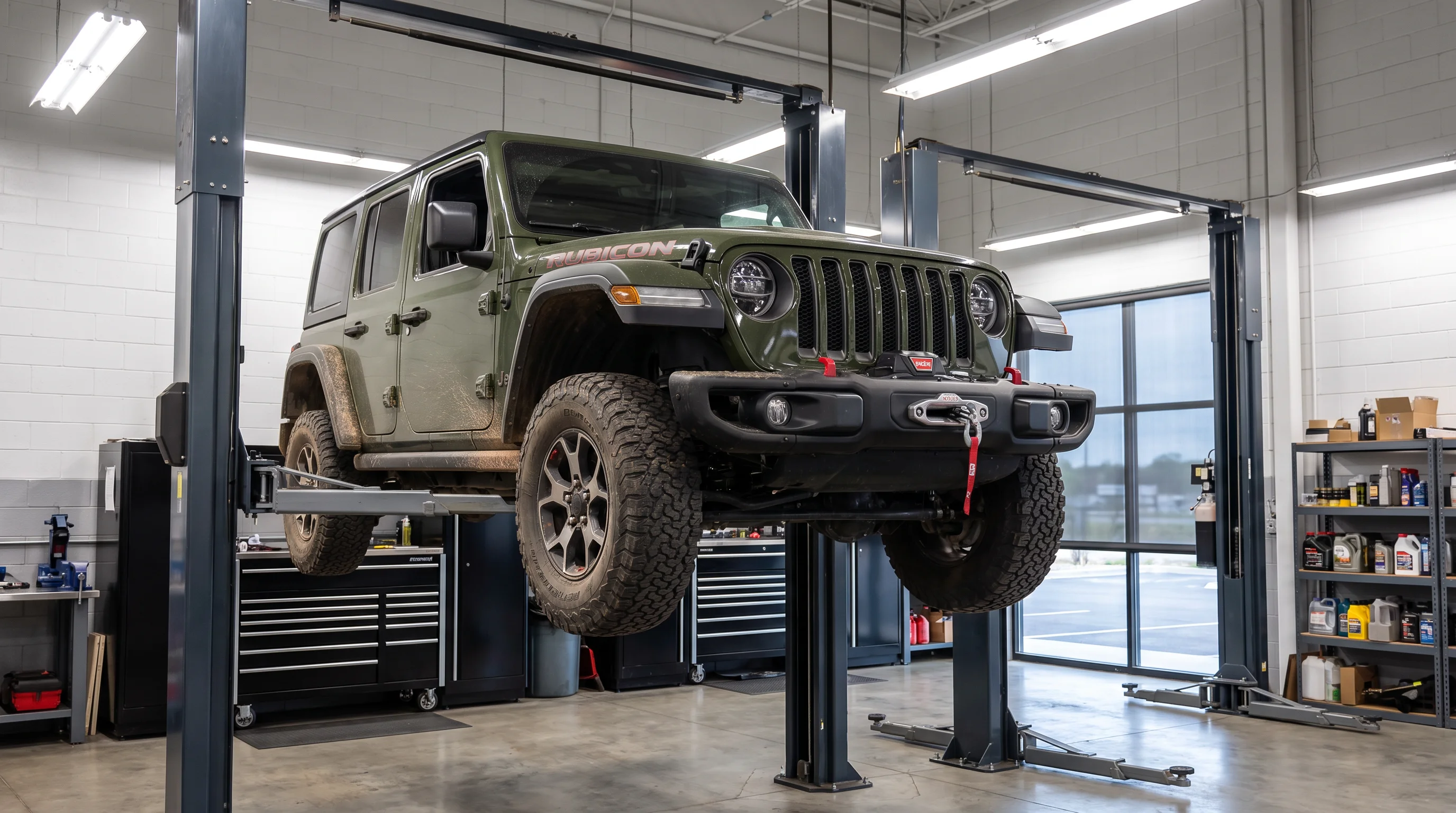
Jeep Service In Yucca Valley: Certified CDJR Technicians
What Routine Services Should You Expect for Your Jeep Wrangler?
Routine maintenance for your Jeep Wrangler at a certified service center starts with a synthetic engine oil and filter change and a tire rotation. Technicians also inspect the brake pads and rotors, check fluid levels, test the battery, and run a multi-point inspection. In high desert conditions, those visits put added weight on engine and cabin air filter condition. They also cover transfer case and differential fluid checks.
Certified technicians watch the parts that take the most strain from heat and fine airborne sand. During a multi-point inspection, they look at suspension bushings, ball joints, shock absorbers, and steering linkages. The goal is to catch steering vibration or worn parts before they turn into a failure. Drivetrain systems get seal and fluid checks too, including the 4x4 transfer case and both axles. That work protects off-road capability and highway manners alike.
Routine visits also cover work that is easy to overlook. Technicians check the serpentine drive belt for heat cracking. They also test how much charge the battery still holds. Catching a worn part at a standard service interval prevents damage to what it is attached to. It keeps your 4x4 running well on pavement and on desert trails alike.
Want advice for your own Jeep? Stop by our service department in Yucca Valley, or call our service team at (760) 369-8997.
What Is the Factory Maintenance Schedule for a Jeep Wrangler?
How the Oil Change Indicator Works
Jeep does not use a single fixed oil change mileage. The Wrangler relies on an automatic oil change indicator that adapts to how the vehicle is actually driven. It may call for service as early as 3,500 miles or as far out as 10,000 miles.
Regardless of what the indicator says, a synthetic oil and filter change should occur no later than 10,000 miles or 12 months, whichever comes first.
Tire rotation is not a separate mileage item. The owner's manual pairs it with the oil and filter change, along with a check of the brake pads, rotors, hoses, and parking brake system, an inspection of the battery, and a look at the engine cooling system and exhaust. If you routinely drive in dusty or dirty off-road conditions, the engine air cleaner is checked at that same visit.
What Happens at Each Service Milestone
| Service Milestone | What Is Performed |
|---|---|
| At every oil change service | Synthetic oil and filter change; tire rotation; brake pad, rotor, hose and parking brake check; battery inspection; engine cooling system and exhaust inspection; engine air cleaner check if driven in dusty or off-road conditions |
| Every 10,000 miles | Inspection of suspension components, braking systems, air filters, spark plugs, and additional items listed in the owner's manual |
| At 100,000 miles | Spark plug replacement, coolant replacement, and transmission fluid replacement |
Alongside the indicator, the Wrangler settles into a 10,000-mile service rhythm. At each of those visits a technician checks the suspension, the brakes, the air filters, the spark plugs, and the other items your owner's manual lists. The pattern repeats to the 100,000-mile mark. That is where Jeep calls for new spark plugs, fresh coolant, and a transmission fluid change.
When Severe-Duty Intervals Apply
Standard intervals assume normal driving. Frequent towing, heavy stop-and-go traffic, and regular off-road running all count as severe-duty operation. So does driving in dust or sand. A Jeep used that way needs fluid and filter attention sooner than the standard schedule suggests.
The information in this article is general guidance and does not constitute a specific diagnostic or repair recommendation for any individual vehicle. Repair and maintenance decisions should be made in consultation with a certified technician based on the specific condition of your vehicle.
How Do Desert Conditions and High Heat Affect Jeep Service Needs?
High desert heat, wide temperature swings, and airborne sand shorten fluid life. They also load up air intake filters and speed up wear on rubber parts. Stellantis treats driving in these conditions as severe-duty operation. That shortens both fluid change and filter replacement intervals compared with the standard schedule.
Heat and Fluid Breakdown
Summer heat puts sustained pressure on cooling systems and batteries. Engine oil loses thermal stability faster under high ambient temperatures than it does in a mild climate.
Airborne Sand and Dust
Sand fine enough to pass through a compromised air intake box contaminates engine oil, and abrasive particles can work into transfer case breathers during trail running.
Heat-Cycled Rubber
Rubber bushings in control arms and track bars dry out faster under repeated heat cycling, which makes routine inspection at every oil change worth the time.
To keep your Jeep on a schedule that reflects how it is actually driven here, talk with a service advisor at our Yucca Valley location.
How Often Should Engine and Cabin Air Filters Be Replaced?
Inspection Beats a Fixed Mileage
Rather than a fixed mileage, filter replacement on a Jeep driven in the high desert is best handled by inspection. Technicians check the engine air filter at every oil change. They recommend replacement whenever dust accumulation restricts light passing through the pleats. Owners who run trails on weekends or drive unpaved roads regularly should expect to replace both filters sooner than a driver in a mild climate would.
Engine Air Filter vs. Cabin Air Filter
The two filters do different jobs, and they fail in different ways.
| Engine Air Filter | Cabin Air Filter | |
|---|---|---|
| What it protects | The engine. It lets the engine breathe, protects intake sensors, and maintains the air-fuel mixture. | The people inside. It traps dust, pollen, and desert particulate before air reaches the climate control system. |
| What happens when it clogs | Intake vacuum rises and can draw fine sand past weak filter seals toward the combustion chamber. | Air conditioner volume drops and the blower motor works harder in summer heat. |
| How replacement is decided | Inspected visually at every oil change. Replaced when dust blocks light through the pleats. | Replaced sooner with heavy dust or trail exposure than a mild-climate schedule would call for. |
Wrangler owners often ask whether desert dust means changing the engine air filter early, especially after weekend trail trips. The answer depends on exposure. That is why the filter is inspected visually at every service rather than swapped on a calendar.
What Affects the Cost of a Routine Jeep Oil and Filter Change?
There is no single flat rate for an oil service. Cost varies with the engine and how much oil it holds. Genuine Mopar oil filters and factory-approved synthetic lubricants keep flow rates and oil pressure relief valve operation where they should be. That protects the timing chain and camshaft actuators.
Of everything you can do for a Jeep, an oil change costs the least and returns the most. Staying on the severe-duty schedule when conditions call for it prevents sludge buildup and valve train wear. It heads off far more expensive engine work later. It also keeps your factory powertrain coverage intact.
For current pricing on oil changes, filters, brakes, and tire service, review our posted service offers. They change from month to month.
This information is provided for general educational purposes only and does not constitute legal advice. Warranty coverage depends on the specific terms of your vehicle's warranty agreement. Consult your owner's manual or a qualified legal professional for guidance on your individual situation.
Does Servicing a Jeep at an Independent Shop Void the Factory Warranty?
What Federal Law Protects
No. The Magnuson-Moss Warranty Act protects you here, and the Federal Trade Commission enforces it. A manufacturer cannot void your coverage or deny a claim just because routine maintenance happened outside a dealership. To deny a claim, it has to show that the outside work or the part used actually caused the failure. Keep detailed service receipts anyway, showing that the work met factory specifications.
Why a Certified Shop Still Helps
A certified shop still brings real advantages. Our technicians run factory diagnostic software that independent shops cannot access. It flags stored trouble codes, pending software updates, and open service campaigns. We also fit genuine Mopar parts built to your Jeep's exact tolerances.
Your Factory Warranty Coverage
| Coverage | Term |
|---|---|
| Bumper-to-bumper | 3 years / 36,000 miles |
| Powertrain | 5 years / 60,000 miles |
Full terms are published on Jeep's official warranty page. If a covered part fails, service records from an authorized dealership make claim approval faster. Our technicians file warranty claims directly with the manufacturer. To check whether an open campaign applies to your Jeep, you can request a recall check.
This information is provided for general educational purposes only and does not constitute legal advice. Warranty coverage depends on the specific terms of your vehicle's warranty agreement. Consult your owner's manual or a qualified legal professional for guidance on your individual situation.
Does Joshua Tree CDJR Offer Shuttle Service?
Yes. Our service department offers shuttle service and drop-off service so you can keep your day moving while technicians work. For shorter visits such as an oil change and tire rotation, you are welcome to wait on site, where the customer lounge offers free Wi-Fi.
Drivers coming from as far as Palm Desert can arrange a ride when they drop a vehicle off for severe-duty maintenance. To confirm shuttle details or set up a drop-off, stop by 57909 29 Palms Hwy in Yucca Valley. You can also call our service team at (760) 369-8997.
Common Questions About Jeep Maintenance in Yucca Valley
How does severe off-road driving affect the 4x4 drivetrain service schedule?
Severe off-roading subjects transfer cases, front differentials, and rear axles to heavy mechanical stress and heat, and driving through deep dust or sand can compromise breathers and fluid seals. Have 4x4 fluid levels inspected after major trail outings rather than waiting for a mileage milestone, and expect transfer case and differential service sooner than a street-driven Wrangler would need it.
What battery care is recommended for high desert heat?
Heat, not cold, is what shortens battery life. Sustained high temperatures accelerate electrolyte evaporation and internal grid corrosion, and batteries in desert climates typically last two to three years rather than the four to five years common in cooler regions. Annual load testing once a battery passes two years of age, along with clean terminals and properly installed heat shields, prevents most unexpected electrical failures.
Why is tire rotation particularly critical on four-wheel-drive Jeep vehicles?
Four-wheel-drive systems rely on uniform tire diameters across all four wheels to prevent drivetrain binding and transfer case wear. Aggressive tread patterns on off-road tires wear unevenly under cornering forces and hot pavement. Rotating at every scheduled oil change promotes even tread depth, reduces road noise, and extends tire life.
What maintenance is unique to plug-in hybrid Jeep models?
Plug-in hybrid models such as the Jeep Grand Cherokee 4xe pair conventional internal combustion components with high-voltage battery cooling systems, electric drive modules, and regenerative braking hardware. Regenerative braking eases wear on the friction brakes, while high-voltage coolant levels and hybrid electrical connections call for specialized inspection during routine visits.
What paperwork should I bring for warranty service?
Bring your current vehicle registration, active insurance card, and any records of maintenance performed elsewhere. Documented service history makes claim validation straightforward for warrantable powertrain and chassis components. If you have a question before you come in, you can ask a technician directly.
This information is provided for general educational purposes only and does not constitute legal advice. Warranty coverage depends on the specific terms of your vehicle's warranty agreement. Consult your owner's manual or a qualified legal professional for guidance on your individual situation.
Keep Your Jeep Trail-Ready with Certified Service in Yucca Valley
Service your Jeep on a schedule that matches desert driving and it will stay reliable longer. That holds whether you commute daily or run trails on the weekend. Factory-certified work covers everything from oil and filter changes to severe-duty drivetrain service. It protects your investment and keeps your factory warranty coverage intact.
Our team at Joshua Tree Chrysler Dodge Jeep Ram has the equipment, the factory-trained technicians, and the genuine Mopar parts your Jeep needs. Talk with a service advisor and build a maintenance schedule around how and where you actually drive.
This information is provided for general educational purposes only and does not constitute legal advice. Warranty coverage depends on the specific terms of your vehicle's warranty agreement. Consult your owner's manual or a qualified legal professional for guidance on your individual situation.
Disclaimers
The information in this article is general guidance and does not constitute a specific diagnostic or repair recommendation for any individual vehicle. Repair and maintenance decisions should be made in consultation with a certified technician based on the specific condition of your vehicle.
This information is provided for general educational purposes only and does not constitute legal advice. Warranty coverage depends on the specific terms of your vehicle's warranty agreement. Consult your owner's manual or a qualified legal professional for guidance on your individual situation.