
What Is the Recommended Maintenance Schedule for a 2018-2027 Jeep Wrangler?
A 2018-2027 Jeep Wrangler runs on an oil change indicator rather than a fixed mileage schedule, and that interval must never exceed 10,000 miles, 12 months, or 350 hours of engine run time, whichever comes first. Everything else follows a fixed mileage ladder: the cabin air filter at 20,000 miles, the engine air filter and transfer case inspection at 30,000, spark plugs on the 2.0L Turbo at 60,000, spark plugs on the 3.6L V6 at 100,000, and the engine coolant flush at 10 years or 150,000 miles.
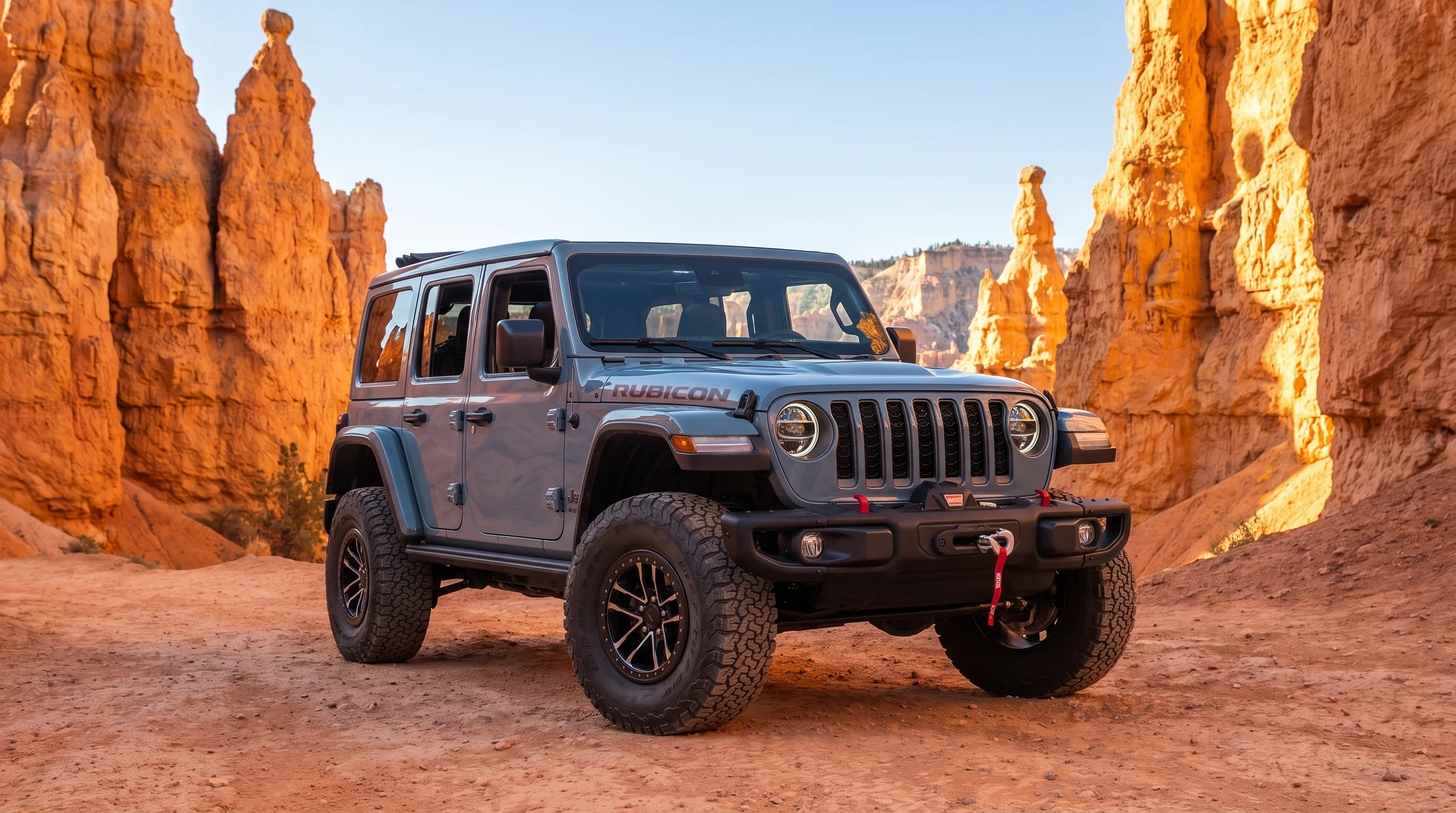
That is the normal schedule. Most Wranglers in the Morongo Basin do not qualify for it. Jeep's severe-duty definition covers dusty and off-road driving, extended idling, sustained very low engine speeds, and frequent trailer towing, which describes how a large share of local Wranglers are actually used. Under severe duty the oil interval drops to 4,000 miles or 350 engine hours, and the drivetrain fluid intervals tighten with it.
Scope note: This guide covers the two gasoline engines offered across the 2018-2027 Wrangler range, the 3.6L Pentastar V6 and the 2.0L turbocharged four-cylinder. The 4xe plug-in hybrid, the 6.4L HEMI V8 392 models, and the 3.0L EcoDiesel follow different service requirements. Call our service team for the schedule on those powertrains.
The information in this article is general guidance and does not constitute a specific diagnostic or repair recommendation for any individual vehicle. Repair and maintenance decisions should be made in consultation with a certified technician based on the specific condition of your vehicle.
Cited Source: Jeep Wrangler Owner's Manual (Mopar) — scheduled maintenance intervals and the maximum oil change interval for the JL generation.
How the Oil Change Indicator Sets Your Service Interval
The oil change indicator is duty-cycle based, meaning the interval shifts with how the vehicle is driven. When the "Oil Change Required" message appears, have the service performed within the next 500 miles. The indicator does not override the maximum boundaries. Even if the message has not appeared, engine oil must not remain in service beyond 10,000 miles, 12 months, or 350 engine hours.
What Gets Checked at Every Oil Change
Every oil change visit covers the same core work:
- Draining the used oil and installing a fresh filter
- Rotating the tires in the rearward cross pattern the owner's manual specifies, including the full-size spare only when it matches the four road tires in size, type, and wear
- Inspecting front and rear brake pads, calipers, rotors, and hoses
- Inspecting the CV and universal joints
- Inspecting the cooling system and hoses
- Inspecting battery terminal connections and testing charge capacity
- Checking fluid levels in the windshield washer reservoir, engine coolant bottle, and brake master cylinder
Our technicians perform factory-scheduled maintenance daily using genuine Mopar fluids and engineered components. Routine work can go through our Jeep service center in Yucca Valley or the quick service lane.
The information in this article is general guidance and does not constitute a specific diagnostic or repair recommendation for any individual vehicle. Repair and maintenance decisions should be made in consultation with a certified technician based on the specific condition of your vehicle.
Cited Source: Jeep Wrangler Owner's Manual (Mopar) — oil change indicator operation, the 10,000-mile/12-month/350-hour ceiling, and the inspection items performed at every oil change.
Jeep Wrangler Maintenance Schedule by Mileage: 20,000 to 150,000 Miles
Oil changes float with the indicator. Everything else lands on fixed odometer readings, and the milestones are not evenly weighted. 30,000 and 100,000 are heavy visits, while 90,000 is comparatively light.
| Mileage Milestone | What's Due |
|---|---|
| Every oil change (max 10,000 mi / 12 mo / 350 hrs) | Oil and filter change, tire rotation, brake inspection, CV and universal joint inspection, cooling system and hose inspection, battery check, fluid level checks |
| 20,000 miles | Cabin air filter replacement; brake lining inspection and parking brake adjustment; inspect front suspension, tie-rod ends, and boot seals; first front and rear axle fluid inspection |
| 30,000 miles | Engine air filter replacement, and again at each later major interval; transfer case fluid inspection; manual transmission fluid change under severe duty |
| 40,000 miles | Front and rear axle fluid change, severe duty only, which Jeep defines to include off-road use and frequent trailer towing (repeats at 80,000 and 120,000) |
| 60,000 miles | Spark plug replacement on the 2.0L Turbo; second front and rear axle fluid inspection; transfer case fluid change under severe duty |
| 90,000 miles | Second transfer case fluid inspection, plus the recurring every-oil-change and 30,000-mile items. A light milestone on this schedule |
| 100,000 miles | Spark plug replacement on the 3.6L Pentastar V6; third axle fluid inspection; PCV valve inspection and replacement if needed; accessory drive belt inspection; water pump inspection |
| 150,000 miles or 10 years | Flush and replace the engine coolant, and the intercooler coolant on turbo models, whichever comes first; third transfer case fluid inspection; accessory drive belt replacement plus tensioner and pulley inspection |
The Two Milestones Worth Budgeting For
Two milestones are worth planning for financially. The 100,000-mile visit on a 3.6L V6 is a bigger job than the mileage suggests, because reaching the plugs requires removing the upper intake manifold. And the coolant interval is time-based as much as mileage-based, so a low-mileage Wrangler still hits the ten-year mark.
The information in this article is general guidance and does not constitute a specific diagnostic or repair recommendation for any individual vehicle. Repair and maintenance decisions should be made in consultation with a certified technician based on the specific condition of your vehicle.
Cited Source: Jeep Wrangler Owner's Manual (Mopar) — mileage-based maintenance schedule including filter, spark plug, drive belt, PCV, water pump, and coolant intervals for the JL generation.
Severe-Duty Intervals for Desert and Off-Road Driving
Jeep's severe-duty schedule calls for an oil change every 4,000 miles or 350 engine hours. It applies to dusty or off-road driving, operation that is mostly idling or at very low engine speed, and frequent trailer towing. In remote communities like Homestead Valley, where unpaved access roads are the norm, severe-duty intervals are the realistic standard rather than the exception.
The triggers that put a Wrangler on the severe-duty schedule:
- Frequent driving on unpaved dirt, sand, or gravel roads
- Extended idling or sustained low-speed operation, including rock crawling
- Frequent trailer towing
It is what moves the axle fluid from an inspection-only item to a 40,000-mile change, brings the transfer case change forward to 60,000, and puts the manual transmission fluid on a 30,000-mile cycle. If more than one trigger describes how you use your Wrangler, the normal-schedule columns are the wrong numbers to plan around.
The information in this article is general guidance and does not constitute a specific diagnostic or repair recommendation for any individual vehicle. Repair and maintenance decisions should be made in consultation with a certified technician based on the specific condition of your vehicle.
Cited Source: Jeep Wrangler Owner's Manual (Mopar) — severe-duty operating conditions and the 4,000-mile/350-hour severe-duty oil interval.
Telling a 2018 Wrangler JK from a JL, and Choosing the Right Oil
2018 was a transition year: the outgoing JK generation and the new JL generation were sold side by side as 2018 models. Since the two do not share an oil specification, confirm which one you have before buying oil or ordering a filter.
Five details separate the two generations from across a parking lot:
| What to Check | JK (2018 only, in this range) | JL (2018-2027) |
|---|---|---|
| Grille profile | Flat, on a single plane | Raked, with a subtle backward bend at the top |
| Headlights | Sit clear of the grille slots | Cut into the outer grille slots |
| Front turn signals and running lights | Below the headlights on the front fascia | On the face of the front fender flares |
| Door handles | Push-button thumb latch | Pull-style lever |
| Ignition | Key turn | Push-button start on most builds |
The 2.0L turbocharged four-cylinder is the one that trips people up. It does not use MS-6395 like the Pentastar engines. It calls for a 5W-30 full synthetic meeting FCA Material Standard MS-13340. Many 5W-30 products on the shelf list MS-6395 and say nothing about MS-13340, so check the label rather than the viscosity alone. If you would rather not sort it out at the parts counter, our oil change service uses the correct specification for your engine.
| Engine | Oil Viscosity | FCA Material Standard | Capacity with Filter |
|---|---|---|---|
| 3.6L Pentastar V6 (JL, 2018-2027) | SAE 0W-20 full synthetic | MS-6395 | 5 quarts |
| 2.0L Turbocharged I4 (JL, 2018-2027) | SAE 5W-30 full synthetic | MS-13340 (API SP/GF-6) | 5 quarts |
| 3.6L Pentastar V6 (JK, 2018) | SAE 5W-20 full synthetic | MS-6395 | 6 quarts |
The information in this article is general guidance and does not constitute a specific diagnostic or repair recommendation for any individual vehicle. Repair and maintenance decisions should be made in consultation with a certified technician based on the specific condition of your vehicle.
Cited Source: Jeep Wrangler Owner's Manual (Mopar) — engine oil viscosity and material standard by engine | ExtremeTerrain — JK and JL fluid capacities and exterior identification points | Quadratec — JK-generation 3.6L Pentastar oil capacity and viscosity.
When Should Differential, Transfer Case, and Transmission Fluids Be Changed?
Drivetrain fluid intervals split sharply between the normal and severe-duty schedules, and the severe-duty column is the one that applies to most trail-driven vehicles. Four-wheel-drive gearboxes operate under high gear-tooth pressures, and clean fluid is what keeps the hardware off metal-to-metal contact.
| Component | Fluid Specified | Inspection Interval | Change Interval |
|---|---|---|---|
| Front and rear axle fluid | SAE 75W-85 GL-5 front; 75W-85 or 75W-140 GL-5 rear depending on axle code, so check the axle tag before buying. Trac-Lok limited-slip axles also need friction modifier | 20,000 miles, then 60,000 / 100,000 / 140,000 | No change scheduled before 150,000 miles under normal use; 40,000 / 80,000 / 120,000 under severe duty |
| Transfer case fluid | Mopar ATF+4 | 30,000 / 90,000 / 150,000 | No change scheduled before 150,000 miles under normal use; 60,000 / 120,000 under severe duty |
| Eight-speed automatic transmission fluid | Mopar ZF 8-speed ATF | No scheduled inspection; the unit is sealed and has no dipstick | Factory fill; serviced on condition, such as water or mud contamination, rather than on a mileage interval |
| Six-speed manual transmission fluid | Mopar ATF+4 | No scheduled inspection | 30,000 miles under severe duty, which the schedule defines to include off-road driving and desert operation |
When local Wrangler owners bring their vehicles into our service bay after weekend trail runs, the question we hear most often is how often differential fluid needs changing after driving through fine desert sand. Our technicians check the differential drain plugs for metal shavings and moisture and replace the gear oil before friction damage sets in. For Wrangler owners across the Morongo Basin, clean drivetrain fluids are what keep traction and gear engagement predictable under load.
The information in this article is general guidance and does not constitute a specific diagnostic or repair recommendation for any individual vehicle. Repair and maintenance decisions should be made in consultation with a certified technician based on the specific condition of your vehicle.
Cited Source: Jeep Wrangler Owner's Manual (Mopar) — front and rear axle, transfer case, and transmission fluid specifications and intervals on the normal and severe-duty schedules | ExtremeTerrain — Wrangler drivetrain fluid specifications by generation.
What Does It Cost to Maintain a Jeep Wrangler Each Year?
RepairPal puts the average annual repair and maintenance cost for a Jeep Wrangler at $694, which it rates as average ownership cost for the segment. Actual spend varies with powertrain choice, driving habits, and how often the vehicle sees off-road use.
Routine maintenance itself stays modest, and the mileage ladder above spreads the bigger items out. What moves the number is wear-item frequency: off-roading shortens the replacement cycle on brake pads, sway bar end links, cabin air filters, and all-terrain tires compared with highway-only driving. Keeping those on schedule through our genuine Mopar parts and service department is generally cheaper than letting them run to failure.
The information in this article is general guidance and does not constitute a specific diagnostic or repair recommendation for any individual vehicle. Repair and maintenance decisions should be made in consultation with a certified technician based on the specific condition of your vehicle.
Cited Source: RepairPal — average annual repair and maintenance cost for the Jeep Wrangler.
Common Questions About Jeep Wrangler Maintenance
How do you reset the oil change indicator light on a Jeep Wrangler?
Without pressing the brake pedal, place the ignition in the ON/RUN position without starting the engine. Slowly depress the accelerator pedal fully to the floor three times within 10 seconds, then place the ignition back in the OFF position. If the message still appears when you restart the engine, the reset did not take. Repeat the procedure, pressing the pedal slowly and fully each time rather than stabbing at it.
What maintenance is required at the 30,000-mile mark?
At 30,000 miles the engine air filter is replaced, the transfer case fluid is inspected, and the accessory drive belt, coolant condition, and hoses are inspected, alongside the oil and filter change, tire rotation, and brake inspection that accompany every service visit. The cabin air filter is not a 30,000-mile item; it is due at 20,000, along with the first front and rear axle fluid inspection. On a manual-transmission Wrangler used off-road, the transmission fluid change also lands at 30,000.
How often should differential fluid be replaced on a Wrangler used off-road?
Off-road use and frequent trailer towing both put a Wrangler on Jeep's severe-duty schedule, which calls for front and rear axle fluid changes at 40,000, 80,000, and 120,000 miles. Under normal use, no axle fluid change is scheduled at all. The fluid is inspected at 20,000 miles and then at 60,000, 100,000, and 140,000. Have it checked sooner than scheduled if the axles have been submerged in deep water or mud.
How can I tell whether my 2018 Wrangler is a JK or a JL?
Look at the front end. A JL has turn signals and running lights on the fender flares, headlights that cut into the outer grille slots, a grille with a subtle backward bend at the top, and pull-style door handles. A JK has a flat grille, turn signals below the headlights, push-button thumb-latch door handles, and a key-turn ignition.
What engine oil type and viscosity does a 2018-2027 Jeep Wrangler require?
It depends on the engine. The 3.6L Pentastar V6 in JL models takes SAE 0W-20 full synthetic meeting FCA Material Standard MS-6395, 5 quarts with filter. The 2.0L turbocharged four-cylinder takes SAE 5W-30 full synthetic meeting FCA Material Standard MS-13340, also 5 quarts with filter. 2018 JK models with the 3.6L V6 specify SAE 5W-20 full synthetic meeting MS-6395.
The information in this article is general guidance and does not constitute a specific diagnostic or repair recommendation for any individual vehicle. Repair and maintenance decisions should be made in consultation with a certified technician based on the specific condition of your vehicle.
If you have a question this guide does not answer, contact our service team and we will confirm what applies to your VIN.
Cited Source: Jeep Wrangler Owner's Manual (Mopar) — oil change indicator reset procedure, scheduled maintenance by mileage, and engine oil specifications by engine.
Schedule Your Jeep Wrangler Service at Joshua Tree CDJR
Maintaining a 2018-2027 Jeep Wrangler on the correct schedule protects the four-wheel-drive hardware, keeps the engine on clean oil, and holds up to the way these vehicles actually get used out here. Whether you are due for a severe-duty oil change, a 30,000-mile filter and inspection visit, or the 100,000-mile spark plug service, our factory-trained technicians have the diagnostic equipment and tooling built for Wranglers.
Visit our service drive at 57909 29 Palms Hwy, Yucca Valley, CA 92284, or call our service team at (760) 369-8997.
Cited Sources
- Jeep Wrangler Owner's Manual (Mopar) — factory maintenance schedule by mileage, oil change indicator operation and reset procedure, severe-duty conditions, engine oil specifications, and drivetrain fluid intervals
- ExtremeTerrain — 2018 Jeep Wrangler JK and JL exterior identification guide, and Wrangler fluid capacities and specifications by generation
- Quadratec — JK-generation 3.6L Pentastar oil capacity and viscosity
- RepairPal — average annual repair and maintenance cost for the Jeep Wrangler
Disclaimers
The information in this article is general guidance and does not constitute a specific diagnostic or repair recommendation for any individual vehicle. Repair and maintenance decisions should be made in consultation with a certified technician based on the specific condition of your vehicle.