

What Type of Oil Does a Ram 1500 Take? Every Model Year, 2010–2027
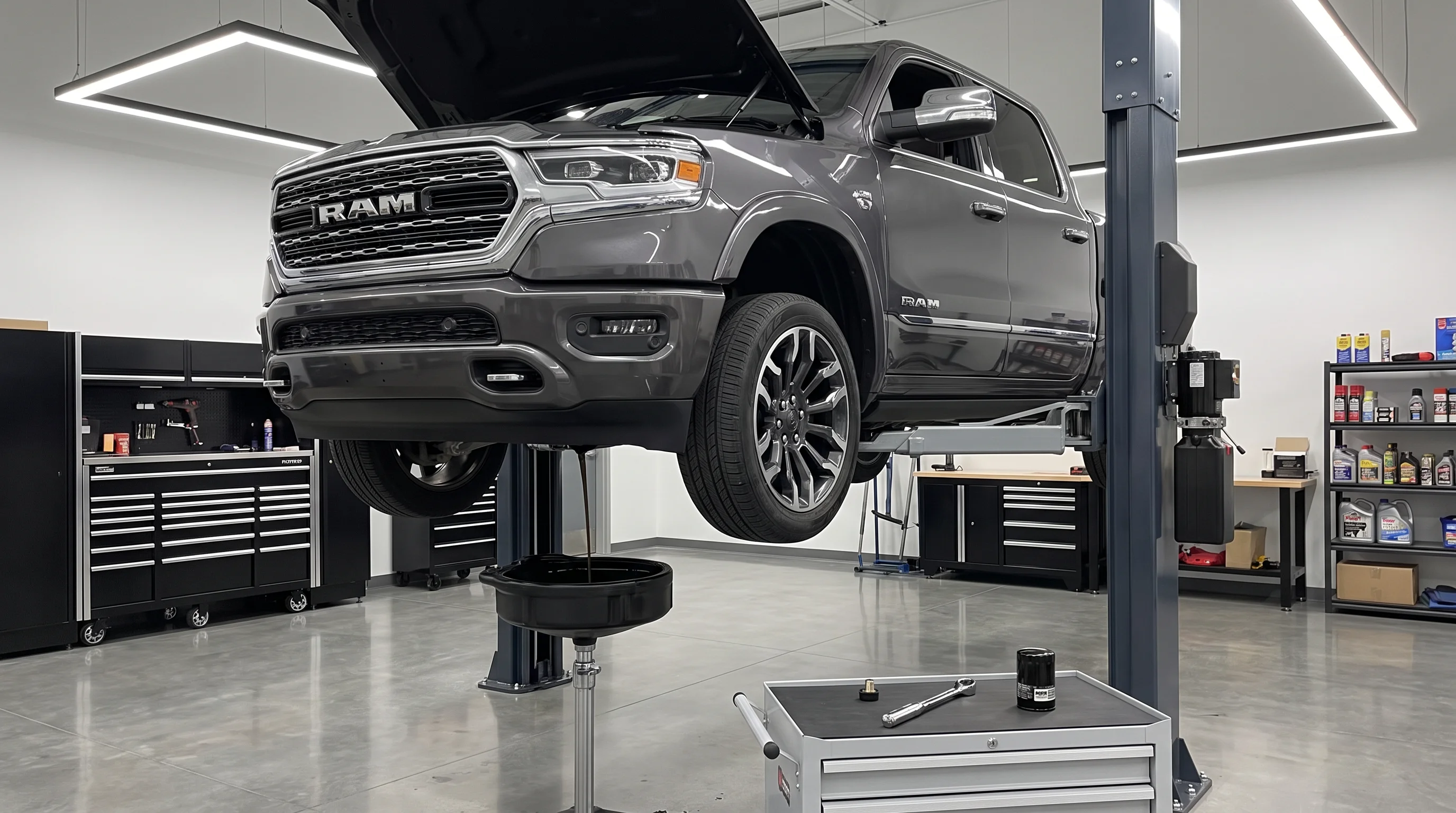
The oil your Ram 1500 needs depends on two things: which engine is under the hood, and which model year the truck is. Both matter. Ram changed the required viscosity on its two highest-volume engines partway through this span. The 3.6L Pentastar moved from 5W-20 to 0W-20 for 2019. The 5.7L HEMI made the same move for 2022. Two trucks wearing the same engine badge can require different oil.
Across model years 2010 through 2027, Stellantis (formerly Chrysler, then FCA) offered thirteen distinct engine-and-model-year specification combinations in the Ram 1500. Each has its own viscosity, its own capacity, and its own Chrysler material standard. Oil that lacks the proper specification can under-lubricate key components. Hydraulic lifters, variable valve timing solenoids, and turbocharger bearings are the parts most at risk.
The single most important thing to get right: the Hurricane High Output engine takes 0W-40, not 0W-20. It is the one engine in the lineup where the wrong bottle of oil sits right next to the correct one on the shelf.
Drivers running unpaved roads around Homestead Valley put extra contamination load on their oil. So does idling on a job site in high-desert heat. In both cases the oil ages faster than the odometer suggests. Our team at our Yucca Valley service center can verify your exact engine code and perform quick, factory-certified oil changes. If you have questions about oil specs for older or newer models, call our service team at (760) 369-8997.
What Oil Specifications and Capacities Apply to Every Ram 1500 Engine?
Find your engine and model year in the table below. Capacities include a filter change.
| Engine | Model Years | Viscosity | Capacity (with filter) | Chrysler Material Standard |
|---|---|---|---|---|
| 3.7L V6 Magnum | 2010–2012 | SAE 5W-20 | 5.0 quarts | See owner's manual |
| 4.7L V8 PowerTech | 2010–2013 | SAE 5W-20 | 6.0 quarts | See owner's manual |
| 3.6L Pentastar V6 | 2013–2018 | SAE 5W-20 | 5.9 quarts | MS-6395 |
| 3.6L Pentastar V6 (incl. eTorque) | 2019–2027 | SAE 0W-20 | 5.9 quarts | MS-6395 |
| 5.7L HEMI V8 | 2010–2021 | SAE 5W-20 | 7.0 quarts | MS-6395 |
| 5.7L HEMI V8 (incl. eTorque) | 2022–2024, 2026–2027 | SAE 0W-20 | 7.0 quarts | MS-6395 |
| 3.0L EcoDiesel V6 (Gen 2) | 2014–2019 | SAE 5W-40 | 10.5 quarts | MS-10902 / API CJ-4 |
| 3.0L EcoDiesel V6 (Gen 3) | 2020–2023 | SAE 5W-40 | 8.5 quarts | MS-12991 / API SN or SP |
| 3.0L Hurricane I6 — Standard Output | 2025–2027 | SAE 0W-20 | 7.5 quarts | MS-6395 / API SP |
| 3.0L Hurricane I6 — High Output | 2025–2027 | SAE 0W-40 | 7.5 quarts | MS-A0921 / API SP |
| 6.2L Supercharged HEMI V8 (TRX) | 2021–2024 | SAE 0W-40 | 7.5 quarts | MS-12633 |
| 6.4L HEMI V8 | 2027 | SAE 0W-40 | 7.0 quarts | MS-A0921 |
| 6.2L Supercharged HEMI V8 (SRT) | 2027 | SAE 0W-40 | 7.5 quarts | MS-A0921 |
How to Read the Table
A few notes before you buy oil:
- The 5.7L HEMI skipped 2025. Ram sold the 2025 Ram 1500 without it and brought it back for 2026 after customer feedback. A 2025 and a 2026 truck can look identical on the lot and take different oil.
- The two Hurricane variants are not interchangeable. The Standard Output takes 0W-20 meeting MS-6395. The High Output — the engine in the RHO — takes 0W-40 meeting MS-A0921. Do not substitute 0W-20 in a High Output engine.
- The two EcoDiesel generations are not interchangeable either. Gen 2 (2014–2019) calls for MS-10902 with the API CJ-4 category. Gen 3 (2020–2023) calls for MS-12991 with API SN or SP. Using one generation's oil in the other can cause turbocharger deposits.
- On Gen 2 EcoDiesel, 5W-30 is a retired spec. The original recommendation was 5W-30 under MS-11106. Ram superseded it in July 2016 with a technical service bulletin moving all Gen 2 EcoDiesels to 5W-40, retroactively — including trucks built before the bulletin.
- API CK-4 is a substitute, not the spec. The Gen 2 EcoDiesel manual calls for API CJ-4. CK-4 is backward-compatible and works, but CJ-4 is what's published.
- 2027 figures for the 6.4L and 6.2L are carried forward. Ram has not published a 2027 Ram 1500 owner's manual. These specifications are confirmed for those engines in other current Stellantis applications and reflect the MS-A0921 standard that superseded MS-12633 for 2021 and later. Confirm against your oil fill cap or manual before service.
- The safest check is the cap, not the calendar. Viscosity is stamped on the oil fill cap under the hood — useful on a truck that has changed hands.
Every oil replacement must include a fresh oil filter designed for your specific engine. Reusing an old filter traps contaminants and restricts oil pressure to critical valve gear. If you are not certain which engine your truck has, our service department can confirm it from your VIN.
The information in this article is general guidance and does not constitute a specific diagnostic or repair recommendation for any individual vehicle. Repair and maintenance decisions should be made in consultation with a certified technician based on the specific condition of your vehicle.
What Oil Change Interval Is Recommended for Ram 1500 Trucks?
Ram governs oil changes through the truck's Oil Change Indicator System rather than a fixed mileage figure, but the owner's manual sets outer limits that the monitor cannot override.
| Condition | Mileage | Time | Engine Run Time |
|---|---|---|---|
| Normal driving (typical) | ~7,500 miles | 12 months | — |
| Normal driving (never exceed) | 10,000 miles | 12 months | 350 hours |
| Severe duty | 4,000 miles | — | 350 hours |
| RHO (Hurricane High Output) | 6,000 miles | 6 months | — |
The 350-hour engine run-time limit is the one most owners have never heard of. It is also the one that matters most for work trucks. A truck idling on a job site to run power accumulates hours far faster than miles. Fleet and contractor use often hits this limit first.
The Oil Change Indicator responds to frequent short trips, trailer towing, extreme ambient temperatures, and E85 fuel use. When the "Oil Change Required" message appears, Ram asks that the truck be serviced within the next 500 miles.
What Counts as Severe Duty?
Ram defines severe duty as operation in a dusty or off-road environment, or operation predominantly at idle or very low engine RPM. Conditions that put a Ram 1500 into that category include:
- Frequent trailer towing or hauling heavy payload near maximum capacity
- Repeated short trips under five miles in hot or cold weather
- Driving on unpaved dirt, gravel, or dusty roads such as those around Homestead Valley
- Extensive engine idling, such as job site power usage or slow traffic crawl
The information in this article is general guidance and does not constitute a specific diagnostic or repair recommendation for any individual vehicle. Repair and maintenance decisions should be made in consultation with a certified technician based on the specific condition of your vehicle.
Is Synthetic Oil Better Than Conventional for Ram 1500 Trucks?
Full synthetic oil is better than conventional for these engines. It resists breakdown at high operating temperatures. It flows quickly during cold starts. And it holds its viscosity across longer service intervals.
Synthetic oil molecules are engineered to uniform sizes. That reduces internal friction compared with refined conventional crude. It matters most in engines with precise hydraulic components, such as the 5.7L HEMI's cylinder deactivation solenoids and the Hurricane's twin turbochargers:
- Thermal stability — resists oxidation and sludge formation under heat from heavy towing
- Cold-flow protection — reaches upper valve train components quickly at startup, minimizing wear during initial cranking
- Shear resistance — holds its weight rating under mechanical stress rather than thinning prematurely
- Engine cleanliness — detergent additives suspend soot and limit carbon buildup on piston rings and intake valves
Beyond performance, synthetic is often not optional. Several of the material standards in the table above — MS-12991, MS-A0921, MS-12633 — cannot be met by conventional oil. On those engines, "synthetic versus conventional" isn't a choice.
The information in this article is general guidance and does not constitute a specific diagnostic or repair recommendation for any individual vehicle. Repair and maintenance decisions should be made in consultation with a certified technician based on the specific condition of your vehicle.
Do eTorque and Hurricane High Output Engines Have Unique Oil Needs?
Ram 1500 models with eTorque mild-hybrid technology use the same oil capacities as their non-eTorque counterparts. That is 7.0 quarts for the 5.7L HEMI and 5.9 quarts for the 3.6L Pentastar. Viscosity is the same too, matched to the model year.
What changes is the duty cycle. The eTorque system shuts off the gas engine at stops and restarts it using a 48-volt belt-starter generator. That frequent cycling increases thermal load and puts extra demand on oil film durability during restarts, which is part of why the standards call for full synthetic.
The Hurricane High Output is the exception that needs stating plainly: it does not share the Standard Output's oil. At 540 horsepower and 521 lb-ft, it runs higher boost pressures. It requires SAE 0W-40 meeting MS-A0921. That is a different viscosity and a different material standard from the Standard Output's 0W-20 and MS-6395. Both hold 7.5 quarts, which makes the capacity look identical while the oil is not. If your truck is an RHO, it has the High Output engine.
The information in this article is general guidance and does not constitute a specific diagnostic or repair recommendation for any individual vehicle. Repair and maintenance decisions should be made in consultation with a certified technician based on the specific condition of your vehicle.
Quick Answers to Common Ram 1500 Oil Maintenance Questions
How do I reset the oil life monitor on a Ram 1500 after an oil change?
Without pressing the brake, cycle the ignition to the ON/RUN position without starting the engine. Use the steering wheel controls to scroll to "Vehicle Info," select "Oil Life," then hold the right arrow or OK button to select Reset and confirm the return to 100%. A second method is published for trims without steering wheel navigation controls: with the ignition in ON/RUN and the engine off, fully press the accelerator pedal slowly three times within ten seconds, then turn the ignition off. If the message reappears at the next start, the reset did not take.
What happens if I use 5W-30 oil instead of 5W-20 in a 5.7L HEMI V8?
Incorrect viscosity is a documented cause of code P0521, which flags the engine oil pressure sensor circuit as out of its calibrated range. On the HEMI it can also disturb the Multi-Displacement System. MDS deactivates four cylinders — numbers 1, 4, 6, and 7 — by routing pressurized oil through solenoids into specialized hydraulic lifters, decoupling the lifter plunger so the valves stay closed. That entire sequence depends on oil reaching a specific pressure at a specific rate. A companion code, P1524, disables MDS as a protective measure when an oil pressure fault is set.
How many quarts of oil does a 3.0L Hurricane engine take?
Both Hurricane variants hold 7.5 quarts with a filter change — but they take different oil. The Standard Output uses SAE 0W-20 meeting MS-6395 and API SP. The High Output uses SAE 0W-40 meeting MS-A0921 and API SP. Verify the level with the dipstick after running the engine briefly and letting the truck rest on level ground.
Why does the 3.0L EcoDiesel require more oil than the gas engines?
Diesel combustion generates significant soot and thermal load, and a larger sump dilutes soot contaminants, controls oil temperature during heavy pulling, and slows breakdown of the diesel-specific additive package. Capacity is generation-dependent: 10.5 quarts for Gen 2 (2014–2019) and 8.5 quarts for Gen 3 (2020–2023), which was redesigned with a smaller sump.
Can I top off with a different oil in an emergency?
Ram publishes a specific material standard for every engine in the table above, and topping off with something that does not meet it means the oil in your engine no longer meets specification. On engines requiring MS-12991, MS-A0921, or MS-12633, conventional oil does not meet the standard at all. If you find yourself low and away from the correct product, call our service department at (760) 369-8997 before adding anything — and if something has already gone in, have a complete oil and filter change performed with the correct specification as soon as possible.
The information in this article is general guidance and does not constitute a specific diagnostic or repair recommendation for any individual vehicle. Repair and maintenance decisions should be made in consultation with a certified technician based on the specific condition of your vehicle.
Schedule Factory-Certified Ram 1500 Service at Joshua Tree CDJR
Keeping up with factory oil maintenance is the best way to ensure your Ram 1500 performs reliably, whether it hauls gear, pulls a work trailer, or handles a daily commute. Our certified technicians use genuine Mopar oil filters and Stellantis-approved oils matched to your engine and model year.
Ready to book routine oil service, a brake inspection, or a fluid check? Visit our Yucca Valley dealership. Or call our service team at (760) 369-8997 to reserve your spot.
Disclaimers
The information in this article is general guidance and does not constitute a specific diagnostic or repair recommendation for any individual vehicle. Repair and maintenance decisions should be made in consultation with a certified technician based on the specific condition of your vehicle.