
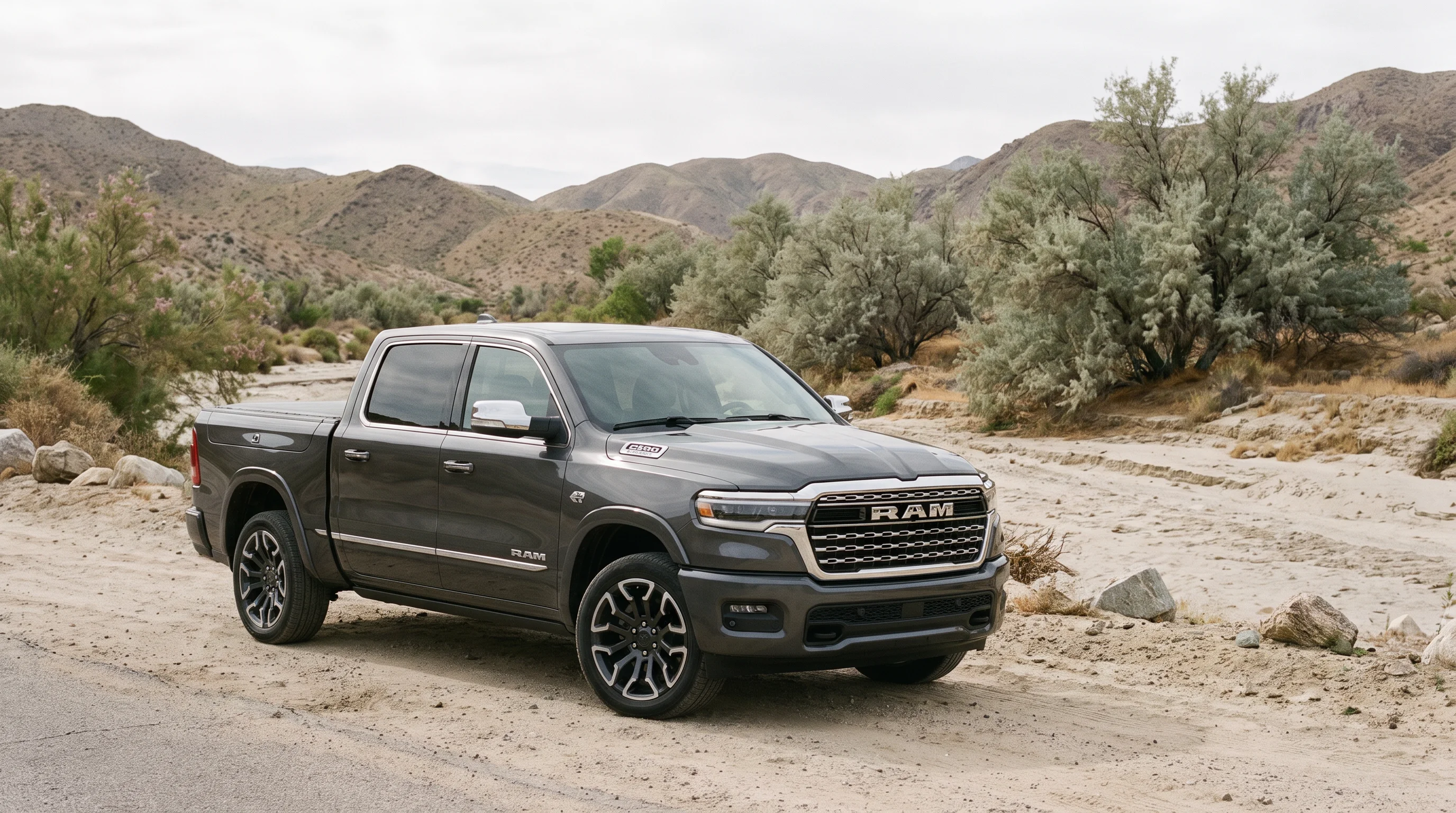
Ram 1500 Routine Maintenance Schedule (2019–2027)
Under normal driving conditions, a 2019–2027 Ram 1500 is serviced on its Oil Change Indicator System rather than a fixed mileage sticker, and that interval must never stretch past 10,000 miles, 12 months, or 350 engine hours, whichever comes first. From there the schedule runs on mileage milestones: the cabin air filter every 12,000 miles, the engine air cleaner filter and axle and transfer case inspections at 30,000 and every 30,000 after, spark plugs at 100,000 miles, and the 4x4 transfer case fluid at 120,000 miles.
Out here, “normal use” is the exception. Dust, extreme heat, unpaved roads, and trailer towing all fall under Ram’s severe operating conditions, and the factory schedule tightens sharply when they apply. The intervals below cover trucks with the 3.6L Pentastar V6 or the 5.7L HEMI V8, the two engines this guide addresses.
The information in this article is general guidance and does not constitute a specific diagnostic or repair recommendation for any individual vehicle. Repair and maintenance decisions should be made in consultation with a certified technician based on the specific condition of your vehicle.
How the Ram 1500 Service Schedule Works
The Oil Change Indicator System watches engine temperature, idle hours, and driving habits, then shows an “Oil Change Required” message when the oil has reached the end of its useful life. Service should be done within 500 miles of that message. Because the system is duty-cycle based, the real interval moves with how the truck is driven. It usually lands somewhere between 4,000 and 10,000 miles.
The ceiling never moves: 10,000 miles, 12 months, or 350 hours of engine run time, whichever arrives first. The 350-hour limit is the one most owners never think about, and it matters most to work trucks that spend long stretches idling.
Two items run on time rather than mileage. Brake fluid is replaced every 24 months no matter what the odometer reads. Engine coolant is flushed at 10 years or 150,000 miles, whichever comes first.
The information in this article is general guidance and does not constitute a specific diagnostic or repair recommendation for any individual vehicle. Repair and maintenance decisions should be made in consultation with a certified technician based on the specific condition of your vehicle.
Cited Source: Ram Owner’s Manual — scheduled-maintenance plan and oil change indicator section
Ram 1500 Maintenance Schedule by Mileage
| Milestone | What Is Due |
|---|---|
| At every oil change, as signaled by the indicator (never beyond 10,000 miles, 12 months, or 350 engine hours) | Change engine oil and oil filter, rotate tires, inspect brake pads, rotors and hoses, complete a multi-point inspection |
| Every 12,000 miles | Replace the cabin air filter, Mopar part 68535623AA, behind the glove box |
| 30,000 miles | Replace the engine air cleaner filter, inspect the front and rear axle surfaces and check fluid level if gear oil leakage is suspected, inspect the transfer case fluid |
| 60,000 miles | Repeat the full 30,000-mile service. Change the transfer case fluid rather than inspecting it if the truck tows frequently, runs off-road, or works in police, taxi or fleet duty |
| 90,000 miles | Repeat the full 30,000-mile service |
| 100,000 miles | Replace the spark plugs on the 3.6L Pentastar V6 and 5.7L HEMI V8, and inspect the PCV valve and replace it if necessary |
| 120,000 miles | Repeat the full 30,000-mile service, and change the transfer case fluid on 4x4 models |
| 10 years or 150,000 miles | Flush and replace the engine coolant, and replace the accessory drive belt where applicable |
| Every 24 months, time-based only | Replace brake fluid |
What Is Due at 30,000 Miles
Thirty thousand miles is the first real milestone past routine oil service. The engine air cleaner filter is replaced. Technicians inspect the front and rear axle surfaces and check the fluid level if gear oil leakage is suspected, and they inspect the transfer case fluid. This same package repeats at 60,000, 90,000 and 120,000 miles, so once you know the 30,000-mile service you know most of the schedule.
What Is Due at 60,000 Miles
Sixty thousand repeats the 30,000-mile service, and it is the milestone owners most often get wrong. Factory fill is not lifetime fill. Even so, the transfer case fluid is inspected here, not changed, unless the truck tows regularly, runs off-road, or works in fleet or taxi duty. Under those conditions 60,000 becomes a change interval. Brake work is the other common misread. Pads, rotors and hoses are inspected at every oil change, not saved for the 60,000-mile appointment.
What Is Due at 90,000 Miles
The 30,000-mile package repeats. Nothing new comes due at this milestone on the gas engines, which surprises owners who expect spark plugs here. Those wait another 10,000 miles.
What Is Due at 100,000 Miles
This is the big one. Spark plugs are replaced on both the 3.6L Pentastar V6 and the 5.7L HEMI V8, and the PCV valve is inspected and replaced if needed. The spark plug interval is mileage-based only, so the years on the truck do not move it. One practical note on cost: the HEMI uses two plugs per cylinder, sixteen in all, while the Pentastar uses six. The same service carries very different labor on the two engines.
What Is Due at 120,000 Miles and Beyond
The 30,000-mile package repeats again, and the transfer case fluid on 4x4 models is changed rather than inspected. At 10 years or 150,000 miles, whichever comes first, the engine coolant is flushed and replaced, and the accessory drive belt is replaced where applicable.
Tire rotation sits outside this milestone grid because it belongs to the oil change visit. Ram calls for rotating at every oil service, and sooner at the first sign of irregular wear, with roughly 10,000 miles or a 2/32-inch difference in tread depth as the practical trigger. Checking tire pressure at the same visit costs nothing. Our oil change service page covers what is included at each visit.
The information in this article is general guidance and does not constitute a specific diagnostic or repair recommendation for any individual vehicle. Repair and maintenance decisions should be made in consultation with a certified technician based on the specific condition of your vehicle.
Cited Source: Ram Owner’s Manual — scheduled-maintenance plan | Mopar OEM parts catalog — cabin air filter 68535623AA
Engine Oil Specifications by Engine
Viscosity on the Ram 1500 is not one number across the generation. It changed mid-run, and using the wrong weight is not a cosmetic error on an engine that relies on oil pressure to run its cylinder deactivation hardware.
| Specification | 3.6L Pentastar V6 | 5.7L HEMI V8 |
|---|---|---|
| Viscosity | SAE 0W-20 full synthetic | SAE 5W-20 full synthetic for 2019–2021; SAE 0W-20 full synthetic from 2022 onward |
| Material standard | Chrysler MS-6395 | Chrysler MS-6395 |
| Capacity with filter | 5.9 quarts | 7.0 quarts |
| Oil filter | Cartridge style, Mopar MO-349 (part 68191349AC) | Spin-on, Mopar MO-339 (part 04892339AA) |
| Spark plugs | 6 plugs, replaced at 100,000 miles | 16 plugs, two per cylinder, replaced at 100,000 miles |
Full synthetic is the requirement, not a recommendation, and a synthetic blend does not satisfy it. Trucks built with the eTorque mild-hybrid system use the same capacities, the same viscosity for their model year, and the same filters as their non-eTorque counterparts. The 48-volt belt-driven motor generator changes how the engine starts and stops. It does not change what the engine drinks.
The 5.7L HEMI’s Multi-Displacement System is the reason viscosity discipline matters. MDS shuts off fuel and spark to four of the engine’s eight cylinders under light load. It does this by routing pressurized oil through solenoids into special hydraulic lifters, which decouple the lifter plungers. The whole sequence depends on oil reaching a specific pressure at a specific rate. Incorrect viscosity is a documented cause of code P0521, the engine oil pressure sensor circuit fault. A companion code, P1524, shuts MDS down as a protective measure when an oil pressure fault is set.
If you want the full breakdown by model year and engine, including filter cross-references, our Ram 1500 oil type and capacity guide covers it in depth.
The information in this article is general guidance and does not constitute a specific diagnostic or repair recommendation for any individual vehicle. Repair and maintenance decisions should be made in consultation with a certified technician based on the specific condition of your vehicle.
Cited Source: Joshua Tree CDJR Ram 1500 oil type and capacity guide | Mopar OEM parts catalog | Ram Owner’s Manual — engine oil and spark plug sections
How Desert Heat, Dust, and Towing Shorten Your Service Intervals
Ram’s owner’s manual carries a Severe Duty note, and for a truck worked in the Morongo Basin it is the schedule that actually applies. The manual is direct: change the engine oil at 4,000 miles if the vehicle is operated in a dusty and off-road environment, or operated mostly at idle or at very low engine RPM. Severe operating conditions can light the oil change message as early as 3,500 miles since the last reset.
What Counts as Severe Duty
- Frequent trailer towing, boat hauling, or carrying heavy bed payloads
- Sustained driving on dusty, unpaved, or sandy roads
- Very short trip driving, stop-and-go traffic, and extreme heat
- Extended engine idling, very low RPM operation, or commercial jobsite work
Severe-Duty Intervals
| Component | Normal Duty | Severe Duty |
|---|---|---|
| Engine oil and filter | Per the indicator, never beyond 10,000 miles or 12 months | 4,000 miles in dusty or off-road operation, or mostly at idle or very low RPM |
| Engine air cleaner filter | Replace at 30,000 miles | Inspect at every oil change |
| Front and rear axle fluid | Inspect at the 30,000-mile intervals | Change at the 30,000-mile intervals for frequent towing, off-road, police, taxi or fleet duty |
| Transfer case fluid (4x4) | Inspect at 30,000-mile intervals, change at 120,000 miles | Change at 60,000 and 120,000 miles |
| Brake fluid | Every 24 months | Every 24 months, unchanged |
A truck that splits its week between pavement and dirt should be scheduled on the dirt. Towing is the clearest case. It loads the engine, transmission and cooling system harder than any commuting mile, and it is exactly the duty cycle Ram calls severe. If you are running that pattern, our quick service lane handles oil and filter changes without an all-day appointment.
The information in this article is general guidance and does not constitute a specific diagnostic or repair recommendation for any individual vehicle. Repair and maintenance decisions should be made in consultation with a certified technician based on the specific condition of your vehicle.
Cited Source: Ram Owner’s Manual — Severe Duty note and scheduled-maintenance plan
What You Can Do at Home and What Needs a Technician
Plenty of routine Ram 1500 maintenance is genuinely do-it-yourself work. Other jobs need factory tooling, training, or a repair order on file. Here is the split.
| Do It at Home | Bring It to the Shop |
|---|---|
| Replace the cabin air filter behind the glove box | Automatic transmission fluid service |
| Replace the engine air cleaner filter | Wheel alignment and axle repair |
| Check oil level on the dipstick | Diagnostic work on the 48-volt eTorque system |
| Top off washer fluid or coolant | Spark plug replacement on the 5.7L HEMI, which carries 16 plugs |
| Reset the oil change indicator after a home oil change | Open safety recalls, which are performed at an authorized dealership at no charge |
Our genuine Mopar parts and service center can confirm the right part number for your year, model and trim before you order.
How to Reset the Oil Change Indicator
On fifth-generation trucks from 2019 onward, the primary path is the Uconnect or instrument cluster menu:
- Turn the ignition to ON or RUN without starting the engine.
- Open Settings, then Vehicle Info, then Oil Life.
- Hold Reset until the display reads 100 percent.
The accelerator pedal method remains available as a backup:
- Turn the ignition switch to the ON position without starting the engine.
- Fully depress the accelerator pedal slowly three times within 10 seconds.
- Turn the ignition switch to the OFF or LOCK position.
If the message comes back when you start the truck, the system did not reset and you can repeat the procedure. Only reset the indicator after the oil and filter have actually been changed.
Recalls and Why They Belong at a Dealership
Open safety recalls are performed at an authorized Chrysler, Dodge, Jeep or Ram dealership at no charge. A real example from this truck’s history: Safety Recall U88, NHTSA campaign 18V-556, covered an inadequate rear axle oil level that could cause axle gears and bearings to overheat, produce a whine or growl, and fail early. Our service team can check your VIN for open campaigns, and Mopar’s recall lookup accepts all 17 digits directly.
The information in this article is general guidance and does not constitute a specific diagnostic or repair recommendation for any individual vehicle. Repair and maintenance decisions should be made in consultation with a certified technician based on the specific condition of your vehicle.
Cited Source: Ram Owner’s Manual — oil change indicator reset procedure | NHTSA Safety Recall 18V-556 owner notification | Mopar recall lookup
Common Questions About Ram 1500 Service and Maintenance
What happens if I exceed the 10,000-mile oil change limit on my Ram 1500?
Oil that stays in service past its useful life thermally breaks down, forming sludge and deposits that restrict tight oil passages. On the 5.7L HEMI V8 that matters more than usual, because the Multi-Displacement System routes pressurized oil through solenoids into hydraulic lifters and depends on reaching a specific pressure at a specific rate. When an oil pressure fault is set, code P1524 disables MDS as a protective measure. Change the oil promptly when the indicator asks for it.
Can I use a synthetic blend instead of full synthetic in my 5.7L HEMI V8?
No. The 5.7L HEMI requires full synthetic oil meeting Chrysler Material Standard MS-6395, in the viscosity specified for your model year: SAE 5W-20 for 2019 through 2021, and SAE 0W-20 from 2022 onward. A synthetic blend does not meet the requirement.
When do the spark plugs come due on a Ram 1500?
At 100,000 miles on both the 3.6L Pentastar V6 and the 5.7L HEMI V8. The interval is mileage-based only, so the age of the truck does not move it. The HEMI uses 16 plugs, two per cylinder, and the Pentastar uses six, which is why the same service costs more on the V8.
How do I know if my Ram 1500 model year has open safety recalls?
Recall applicability depends on your truck’s specific 17-digit Vehicle Identification Number. Ram 1500 campaigns have addressed items such as rear axle oil fill level, the subject of Safety Recall U88 and NHTSA campaign 18V-556. You can check your VIN through Mopar’s recall search or contact our service desk and we will look it up for you.
Does the eTorque system change my maintenance schedule?
Not where oil is concerned. eTorque trucks use the same oil capacity, viscosity and filters as their non-eTorque counterparts, because the 48-volt belt-driven motor generator and its lithium-ion battery sit outside the engine’s lubrication circuit. The battery pack is air-cooled, and the system keeps a conventional 12-volt battery charged through a DC-to-DC converter. Worth noting for newer trucks: Ram confirmed in August 2026 that eTorque is being phased out of the 5.7L HEMI V8 for the 2027 model year, with a small number of 2027 trucks still built with it during the production changeover.
How often should I replace the transfer case fluid on a 4x4 Ram 1500?
Under normal driving, the transfer case fluid is inspected at the 30,000-mile intervals and changed at 120,000 miles. If you tow frequently, haul heavy payloads, or run the truck off-road, the schedule moves up: change the fluid at 60,000 and 120,000 miles rather than inspecting it alone.
The information in this article is general guidance and does not constitute a specific diagnostic or repair recommendation for any individual vehicle. Repair and maintenance decisions should be made in consultation with a certified technician based on the specific condition of your vehicle.
Cited Source: Ram Owner’s Manual — scheduled-maintenance plan | Mopar recall lookup | MoparInsiders — Ram 2027 eTorque phase-out announcement
Book Ram 1500 Service in Yucca Valley
Ready to get your Ram 1500 back on schedule? Our service team in Yucca Valley handles oil and filter changes, tire rotations, filter replacements and full multi-point inspections for drivers across Yucca Valley, Joshua Tree and Twentynine Palms. Book online or call the service desk at (760) 369-8997. More maintenance guides live on our Service & Parts Tips hub.
Cited Sources
- Ram Owner’s Manual — scheduled-maintenance plan, Severe Duty note, oil change indicator reset procedure
- Mopar OEM parts catalog — cabin air filter 68535623AA
- Mopar recall lookup
- NHTSA Safety Recall 18V-556 owner notification letter
- MoparInsiders — Ram 2027 eTorque phase-out announcement
- Joshua Tree CDJR Ram 1500 oil type and capacity guide
Disclaimers
The information in this article is general guidance and does not constitute a specific diagnostic or repair recommendation for any individual vehicle. Repair and maintenance decisions should be made in consultation with a certified technician based on the specific condition of your vehicle.